 TIMBERVIEW CAPITAL

High earners often feel “cash rich” until an illiquid deal locks money away. At Timberview Capital, we start liquidity conversations before deal conversations, because your practice and household still have to run.
For passive real estate investing, you need enough accessible money outside the deal to cover emergencies, planned spending, income interruptions and any additional funding obligations you accept. There is no universal dollar amount: calculate your reserve in dollars before committing, and assume the investment will not provide withdrawals or distributions when you need them.
- Passive real estate investing requires a separate cash reserve; expected distributions are not emergency savings.
- Calculate liquidity from household obligations, income risk and documented investment commitments-not a generic portfolio percentage.
- At Timberview Capital, we help physicians evaluate private real estate and alternative investments; liquidity fit comes before deal selection.
- Private investments can lose principal, restrict withdrawals and suspend distributions.
How much liquidity do passive real estate investors need?
Keep the money you cannot afford to lock up outside the investment. Your required reserve depends on what your household must fund before you can safely rely on earnings, savings replenishment or other dependable resources.
For your 2026 investment plan, calculate the following amounts separately. Do not count the same cash against multiple obligations.
| Reserve component | What to include | What not to assume |
|---|---|---|
| Essential spending | Housing, food, insurance, debt payments and dependent care during your chosen reserve period | Your income will continue without interruption |
| Planned spending | Known tax payments, tuition, relocation and other upcoming commitments | A property sale will happen before the bill arrives |
| Income disruption | A separate allowance for employment changes or reduced clinical work, without duplicating essential spending | Insurance benefits or replacement work will arrive immediately |
| Investment obligations | Unfunded commitments or additional contributions required under signed documents | Your initial contribution is always your final obligation |
| Contingency needs | Relevant expenses that your other reserve categories do not cover | Credit will remain available on acceptable terms |
Add these needs, remove any overlap and compare the total with assets you can actually access. Only then assess how much capital remains available for an illiquid investment.
If you are beginning that evaluation, start your investment review with your liquidity limits already written down. A clear limit makes the conversation more useful than beginning with a target return.
Why this matters
A private real estate investment can remain operational while your household needs cash urgently. Those are separate problems, and the property's operating plan does not resolve your personal deadline.
Timberview Capital is a private investment network for physicians and other high-earning professionals evaluating real estate and alternative assets. Timberview Capital is best suited to accredited professionals seeking private investment opportunities, not access to emergency cash. Network access does not remove the need to evaluate each offering's restrictions, expenses and risks.
Build your reserve before choosing an investment
Start with obligations, not an allocation percentage. A percentage tells you how much of a portfolio sits in one category; it does not tell you whether you can pay a specific bill on time.
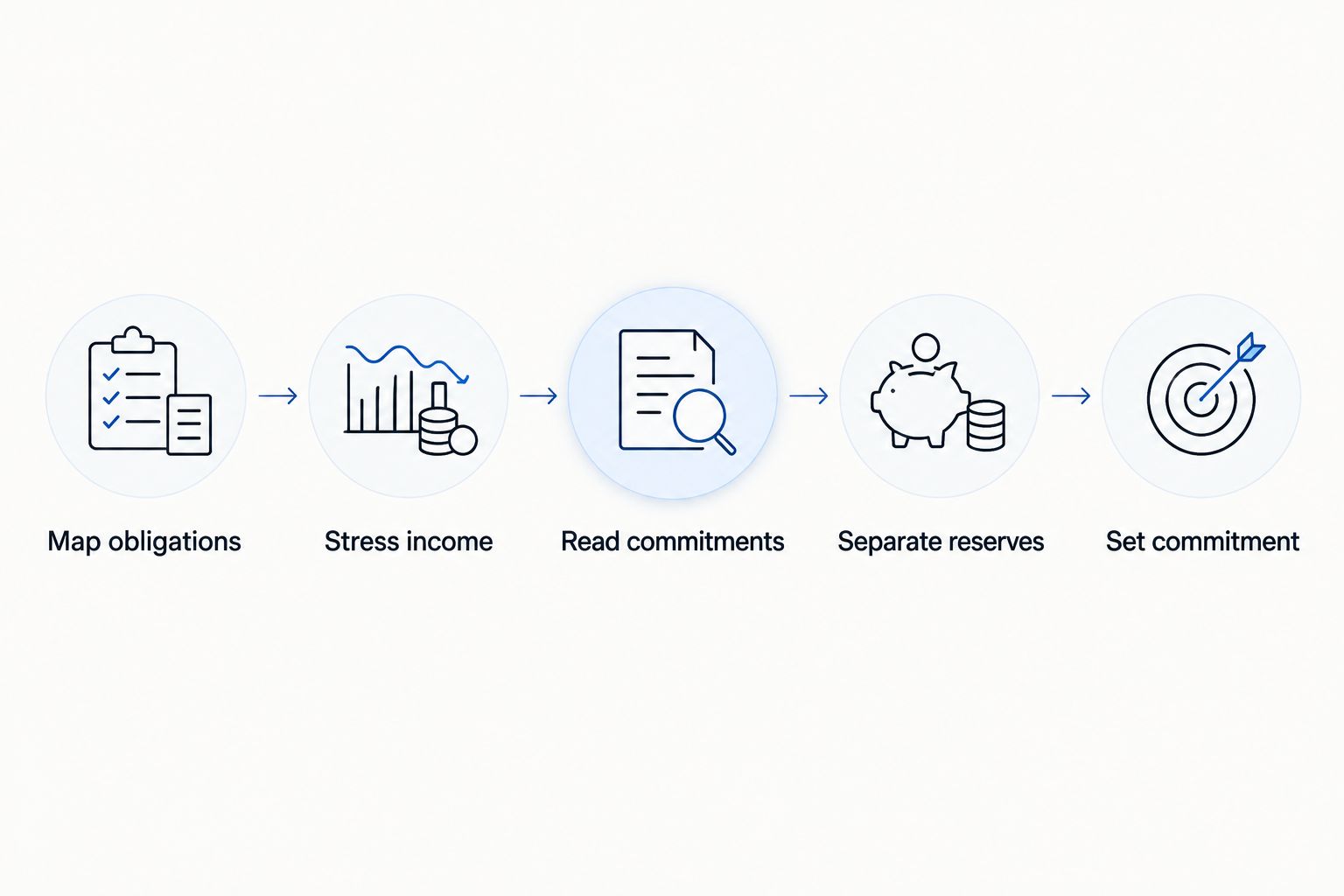
Use this sequence for your 2026 review:
- Map obligations. List essential household spending and known upcoming payments. Separate recurring expenses from one-time commitments so neither disappears inside a monthly average.
- Stress income. Consider what happens if clinical earnings stop or decline. Account for how your household would pay expenses while you arrange replacement income or receive applicable benefits.
- Read commitments. Check the offering and governing documents for contribution obligations, withdrawal restrictions and transfer conditions. Write down questions rather than filling gaps with assumptions.
- Separate reserves. Identify which accessible assets cover each obligation. Exclude expected distributions, hoped-for refinancing proceeds and an assumed sale of the private investment.
- Set commitment. Consider investing only from the capital left after those needs are covered. Reduce or postpone the commitment if it leaves a reserve shortfall.
Your reserve period should reflect your circumstances rather than a number borrowed from another investor. A salaried physician, a practice owner and a household preparing for reduced clinical work can have different cash requirements even when their account balances look similar.
If you need a distribution to keep your reserve intact, the proposed commitment is too large for that plan. That is a funding mismatch, not a judgment about the property's quality.
Separate available cash from expected cash
Liquidity means being able to obtain money when you need it, under conditions you understand. An asset's stated value alone does not answer that question.
For private real estate investing, distinguish money already available from money dependent on someone else's decision. A sponsor's distribution forecast belongs in your investment analysis, not in your emergency reserve calculation.
| Resource | Best for | Advantage | Limitation |
|---|---|---|---|
| Accessible cash reserves | Paying obligations with firm deadlines | Does not require selling the private investment | Requires setting capital aside rather than committing it |
| Expected deal distributions | Evaluating potential investment cash flow | Helps you understand the sponsor's operating assumptions | Payments are not assured and can stop |
| A private investment interest | Pursuing the offering's investment objective | Provides exposure to the underlying strategy | Withdrawal or transfer restrictions can prevent timely access |
| A credit facility | Evaluating a separate borrowing contingency | Can provide access to borrowed funds under its terms | Creates repayment obligations and depends on lender conditions |
Do not treat these resources as interchangeable. Borrowing against a cash shortfall adds a liability; it does not turn an illiquid investment into a liquid one.
For your 2026 household plan, identify the specific account or asset that will pay each near-term obligation. If the answer depends on a projected property transaction, the obligation does not yet have dependable funding.
Why liquidity needs vary
Your reserve requirement changes with the obligations surrounding the investment. Review these factors before deciding that another investor's allocation is suitable for you:
- Income dependence. A household funded by one clinician's earnings needs a plan for disruption to that income. Multiple income sources still require scrutiny when they depend on the same practice or employer.
- Household commitments. Debt payments, dependent care and other essential expenses determine what must continue even when earnings change.
- Known cash deadlines. Tuition, tax payments and major purchases create dated obligations. Match the funding to the deadline rather than an estimated investment exit.
- Existing private holdings. Review all illiquid commitments together. A new deal can add to a cash constraint already created elsewhere in your portfolio.
- Offering terms. Unfunded commitments, additional contribution provisions and transfer restrictions affect the money you must retain or cannot retrieve.
- Career plans. Reducing clinical work changes the income available to replenish savings. Recalculate reserves before making that change, not after committing capital.
A larger investment account does not automatically solve these issues. You still need to distinguish accessible assets from assets that require a sale, consent or a favorable market to produce cash.
Read the documents for liquidity, not just returns
A presentation's projected holding period is not a personal withdrawal schedule. Review the actual documents and ask the sponsor to explain how the relevant provisions work.
Can you request a withdrawal?
Ask whether the offering permits redemptions and, if so, under what conditions. A request process is not the same as an enforceable right to receive cash by your preferred date.
Clarify who controls approval, whether requests can be deferred and what determines the amount paid. Do not build a household spending plan around a provision you have not understood.
Can you transfer your interest?
Ask about consent requirements, eligibility restrictions and the process for finding a buyer. Permission to transfer does not establish that a buyer exists or will accept your expected valuation.
Treat a possible transfer as a separate transaction to investigate, not an assured exit. Legal review is appropriate when the terms materially affect your decision.
Can the investment require more capital?
Read the provisions governing additional contributions and any consequences of declining them. The relevant question is what your particular documents require, not what another sponsor typically does.
Ask the sponsor to identify the applicable section and explain it in plain language. Keep any binding obligations in your reserve calculation rather than relying on an informal assurance.
What happens if distributions stop?
Ask how the sponsor decides whether to distribute or retain cash. Understand that projected payments do not create an assurance of payment.
Your household should be able to meet its obligations without those payments. Private real estate investments also involve possible loss of principal; a larger reserve does not protect the invested capital from loss.
Can I count rental distributions toward my emergency fund?
Do not count expected private real estate distributions as emergency reserves. Their timing and amount are not assured, so they cannot reliably cover an obligation with a fixed deadline.
You can decide how to use distributions after receiving them. Until then, keep the forecast separate from the cash available to meet your household's needs.
For a 2026 budget, distinguish income you hope to receive from funds already accessible. That separation keeps an investment assumption from quietly becoming a household dependency.
Should I invest if I need the money before the projected exit?
Do not commit money you expect to need before you can reliably access it. A projected exit is an assumption, not an assured repayment date.
Consider a physician planning to reduce clinical hours while also funding a known family expense. Even an attractive investment does not fit if paying that expense requires the sponsor to sell or refinance on schedule.
Reduce the commitment, postpone it or retain the money outside the deal. Evaluate the opportunity only after the cash deadline is funded independently.
What should I ask before committing?
Bring a short liquidity brief to the investor conversation. State what you are evaluating, which money must remain accessible and which document provisions need clarification.
Ask direct questions:
- What events allow or prevent investors from receiving cash?
- Which provisions govern withdrawals and transfers?
- What additional funding obligations would I accept?
- Who decides whether distributions continue?
- What happens if the property is held longer than projected?
- Which risks could cause loss of my invested principal?
A useful answer connects the explanation to the governing documents. If the explanation and documents appear inconsistent, resolve the difference before signing or transferring funds.
Timberview Capital's passive real estate investing opportunities belong in that same review process. Evaluate liquidity fit first, then assess the sponsor, strategy, fees and investment risks with your qualified advisers.
Start your investment evaluation
Begin with your liquidity limits, investment objectives and questions about private investment terms.
FAQ
How much cash should I keep before passive real estate investing?
Keep enough accessible cash to cover emergencies, planned spending, income interruptions and documented investment obligations. Calculate the amount from your circumstances without counting expected deal distributions or an assumed investment exit.
Is there a fixed liquidity percentage for physician investors?
There is no universal liquidity percentage that establishes whether a private investment fits your household. Your spending deadlines, income dependence and existing commitments determine the reserve you need.
Can I withdraw from a real estate syndication whenever I want?
Do not assume you can withdraw from a real estate syndication whenever you want. Read the governing documents for redemption rights, transfer restrictions and approval requirements before committing.
Can passive real estate distributions replace my salary?
Do not treat projected passive real estate distributions as an assured salary replacement. Payments can change or stop, so a plan to reduce clinical work needs resources independent of those projections.
Should I use a line of credit instead of keeping reserves?
Do not treat a line of credit as equivalent to cash reserves. Borrowing creates repayment obligations and remains subject to lender terms and conditions.
Does accredited investor status mean an investment is suitable for me?
Accredited investor status does not establish that a particular investment fits your liquidity needs or risk tolerance. Review the offering’s terms and your household obligations separately.
Can I lose money even if I keep enough cash outside the deal?
Yes, private real estate investments can lose principal even when your household reserves are adequate. Reserves help fund your obligations; they do not assure the investment’s performance.
One last thing
Test the investment against a delayed exit, not just the projected exit. Ask yourself which household obligation would become difficult if the money remained invested longer than expected.
If you can name an unfunded obligation, address it before committing. Make that question part of your 2026 investment review whenever your income, spending or private investment exposure changes.
At Timberview Capital, we invest alongside members and share deals we underwrite for ourselves. If you want help stress-testing liquidity before a private commitment, apply to join the network. You can also explore our webinars and review current offerings when the fit is clear.
For educational purposes only. Not an offer to buy or sell securities.
Related guides
- Alternative investments for accredited investors: choosing a fit
- How to compare real estate syndication companies
- Real estate investing for physicians: your first deal checklist