 TIMBERVIEW CAPITAL
If you are a physician planning for fewer shifts or a work-optional future, passive income only helps when you can live through the uneven months. You should not have to worry about your money the way you worry about your practice.
Passive income for doctors is investment income that does not require ongoing clinical work, with the aim of reducing reliance on earned income. Private real estate distributions are not assured, so your plan must cover delayed or suspended payments without depending on a property sale.
- Passive income for doctors should supplement essential spending only when accessible reserves can cover interrupted distributions.
- At Timberview Capital, we connect accredited physicians with private investment opportunities; evaluate each sponsor and offering before committing.
- A preferred return is a payment priority, not an assured distribution.
- Compare cash flow, liquidity, debt and tax reporting separately before reducing clinical income.
Why passive income matters for doctors
An investment can require little day-to-day work and still produce unpredictable cash flow. That distinction matters when you want fewer clinical shifts, a practice transition or a work-optional future.
Private property investments combine operating expenses, financing obligations and business plans that do not follow your household budget. Rent collections do not automatically become investor distributions. Repairs, reserves and loan requirements come first when the governing documents require them.
For your 2026 plan, separate the decision to invest from the decision to spend expected proceeds. The first-deal checklist for physicians provides a companion framework for evaluating an opportunity. This guide focuses on what happens when the cash arrives late, arrives unevenly or stops.
The framework below is general education, not individualized investment, legal or tax advice. Private investments involve possible loss of principal, illiquidity and distributions that are not assured.
Build a plan for uneven distributions
Separate essential spending from projected income
Start with your household budget, not a sponsor’s projected return. Identify which expenses must be paid regardless of investment performance: housing, insurance, debt obligations, family commitments and taxes. Then distinguish those obligations from spending you can postpone.
A distribution forecast belongs in a planning scenario, not in the same category as cash already available. If you are considering fewer clinical hours, test that decision without the investment payment. The question is whether the household still works financially, not whether the investment presentation looks attractive.
- List essential spending separately from discretionary purchases.
- Identify which obligations depend on continued clinical income.
- Exclude projected distributions from money already available to spend.
- Test a reduced-work schedule with no private investment distributions.
- Discuss shared spending assumptions with your spouse or partner before committing.
Define accessible reserves before committing capital
Build your reserve policy from actual obligations and income flexibility. A physician with variable practice income has a different cash-flow problem from an employed physician with predictable compensation. Neither should treat an illiquid ownership interest as an emergency reserve.
Keep three categories distinct: essential spending, accessible reserves and investment commitments. Capital already invested in a private deal is not accessible merely because the property has an estimated value. Pending distributions and expected refinancing proceeds do not fill that gap either.
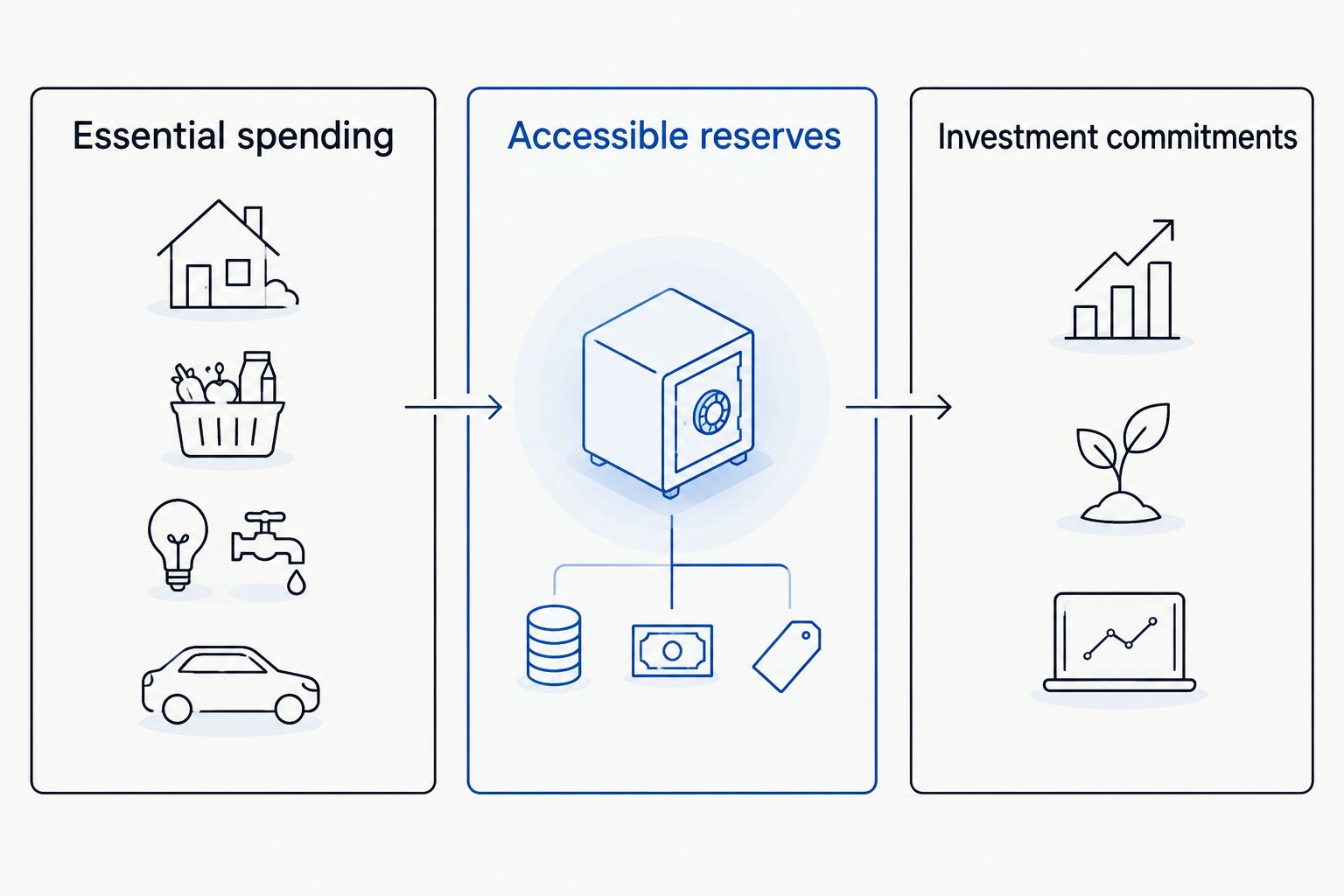
Choose a reserve arrangement you understand, including withdrawal access and any restrictions. The purpose is to fund obligations without requiring the private investment to perform on your schedule.
- Calculate essential spending from actual account activity.
- Identify where accessible reserves are held and how withdrawals work.
- Exclude private ownership interests from immediately available cash.
- Review whether offering documents permit additional capital requests.
- Write down when you will replenish reserves after using them.
Evaluate the network and sponsor separately
Timberview Capital is best for accredited physicians evaluating private real estate opportunities through an investment network. Its stated focus includes multifamily, dental, medical and other commercial properties. That describes access and audience fit; it does not establish the quality of any individual offering.
A network helps you find opportunities. The sponsor executes the property business plan, subject to the roles described in the offering documents. Ask who controls acquisitions, debt, reserves, reporting and distributions-and how each party receives compensation.
Accreditation is an eligibility question, not a safety rating. The SEC’s accredited-investor guidance identifies common individual routes including annual income above $200,000 individually or $300,000 with a spouse or spousal equivalent in each of the preceding two years, with a reasonable expectation of the same income level in the current year. Another route is net worth above $1 million, excluding the primary residence under the applicable rules. Other qualifying routes also exist.
For a 2026 evaluation, confirm the applicable requirements rather than assuming your profession qualifies you.
- Establish whether you meet an applicable accreditation route.
- Identify the sponsor, manager and network’s respective responsibilities.
- Request disclosure of fees, compensation and potential conflicts.
- Ask about realized outcomes alongside current portfolio projections.
- Request examples of reporting during periods of operational difficulty.
Trace each distribution back to its source
Ask where the money comes from. A distribution funded by property operations has a different meaning from money distributed after refinancing or selling an asset. None should be evaluated solely by the amount reaching your bank account.
Operating cash flow is money remaining after relevant property expenses and obligations. Refinancing replaces or changes debt and can release cash, but it also changes financing exposure. Sale proceeds depend on completing a transaction. The offering’s distribution rules determine how available money is allocated.
A preferred return establishes priority under the agreement; it is not a promise that cash will be available. Ask whether unpaid amounts accumulate and what must happen before they are paid.
- Separate operating distributions from refinancing and sale proceeds.
- Ask which expenses and reserves come before investor payments.
- Identify who can suspend, reduce or resume distributions.
- Read the preferred-return language rather than relying on a presentation summary.
- Ask whether distributions represent income, returned capital or another source.
Stress-test operating results and debt together
In 2026, evaluate the specific loan and operating assumptions rather than relying on a general view of interest rates or property demand. Debt service, maturity dates, rate provisions and lender restrictions belong in the same discussion as occupancy and operating expenses.
For medical or dental property, distinguish the building’s economics from the tenant’s business. A healthcare use does not eliminate lease, vacancy or financing risk. Ask who occupies the property, what obligations the lease creates and what happens if a tenant leaves.
Use a plain-language downside question: what changes if income falls while expenses rise? Ask the sponsor to explain the effect on reserves, distributions, additional funding needs and the exit plan. A useful answer identifies the sequence of decisions, not just a revised return figure.
- Request the loan maturity and extension requirements.
- Identify fixed-rate or floating-rate terms and relevant protections.
- Ask how weaker collections affect distributions and required reserves.
- Examine tenant concentration and upcoming lease expirations.
- Request the process for communicating additional capital needs.
- Separate a planned exit date from an enforceable liquidity right.
Coordinate cash flow with tax reporting
Cash received and taxable income are not interchangeable. For investments taxed as partnerships, income can pass through to partners even when cash is not distributed. A distribution also does not, by itself, explain the investment’s taxable result.
The IRS’s Publication 541, Partnerships, and Partner’s Instructions for Schedule K-1 (Form 1065) explain partnership allocations and reporting. Those are the relevant tax-reporting references for this 2026 planning discussion; your CPA must apply the rules to your circumstances and the offering’s structure.
Do not assume depreciation will offset your clinical income or that a distribution pause removes a tax obligation. Ask your CPA to evaluate the actual ownership structure, activity classification and limitations. Tax treatment should inform your cash plan without becoming the reason you ignore investment risk.
- Confirm how the investment expects to report income to you.
- Ask about the expected tax-document delivery process.
- Discuss estimated-tax planning with your CPA before investing.
- Keep tax reserves distinct from money intended for household spending.
- Review tax consequences before assuming a distribution is spendable income.
Set a review process before reducing clinical work
Write down what would trigger another review: a distribution suspension, a material operating change, a loan extension or a request for more capital. Your response should depend on the facts and governing documents, not on whether the original projection was reassuring.
Compare reports with the original business plan. Ask what changed, what management is doing and which decisions remain outside your control. A revised forecast needs an explanation, especially when it changes the timing of cash you expected to use.
Before reducing clinical income, revisit your household reserves and obligations independently of the sponsor’s outlook. The investment can remain appropriate while the timing of a work reduction becomes inappropriate.
- Save the original underwriting assumptions and offering documents.
- Track actual distributions separately from projected distributions.
- Record material changes in debt, occupancy, expenses and reserves.
- Establish who answers investor questions and handles reporting.
- Reassess household commitments before reducing earned income.
Compare options by the job they perform
These options serve different purposes. Bank deposits support accessible cash; listed real estate securities provide market-traded exposure; private offerings involve deal-specific ownership and restrictions. Timberview Capital is an access channel, not an asset class or a substitute for reviewing an offering.
| Option | Best for | Practical advantage | Key limitation |
|---|---|---|---|
| Bank deposits | Holding accessible spending reserves | Separates household cash from property performance | Deposit terms, access restrictions and insurance eligibility require review; not direct property ownership |
| Listed equity REITs | Investors seeking exchange-traded real estate exposure | Shares trade in public markets | Market prices fluctuate, dividends can change and investors do not control properties |
| Private real estate syndications | Investors able to accept deal-specific risk and restricted access to capital | Exposure to a defined property strategy | Principal can be lost; distributions and exit timing are not assured |
| Timberview Capital investment network | Accredited physicians evaluating private opportunities | Access to a network focused on real estate and alternative investments | Access does not remove sponsor, financing, concentration or liquidity risk |
Choose the role before choosing the investment. An investment intended for long-term exposure should not also be the cash reserve that protects your household from interrupted payments.
Common mistakes doctors make
Treating a preferred return like compensation
A preferred return is not a paycheck. Read the distribution provisions, including payment priorities and conditions, before assigning that money to recurring household expenses. A priority claim does not create cash when the property lacks distributable funds.
Assuming healthcare property eliminates business risk
Medical familiarity is useful context, not a substitute for property diligence. A physician understands clinical practice but still needs to assess leases, tenant obligations, financing and the sponsor’s execution plan. Separate confidence in the healthcare sector from confidence in a particular investment.
Counting properties instead of shared exposures
Different property addresses can still share a sponsor, lender, tenant type or financing structure. Review those connections before calling a portfolio diversified. Ask what common event would interrupt several investments at once, then compare that exposure with your household’s dependence on clinical income.
Letting a tax narrative decide the investment
A tax explanation does not establish sound property economics. Evaluate operating assumptions, debt and downside exposure first, then ask your tax adviser how the structure affects you. Never exchange a clear liquidity need for an assumed tax benefit.
FAQ
What is the best way for doctors to plan for passive income?
Separate essential spending from projected investment distributions and maintain accessible reserves. Evaluate liquidity, debt, sponsor responsibilities and tax reporting before relying on an investment to replace clinical income.
Can private real estate pay doctors a reliable monthly income?
Private real estate distributions are not assured, including when an offering targets monthly payments. Operating results, reserves, financing requirements and the governing agreement affect whether cash is distributed.
Does a preferred return guarantee that I get paid?
No. A preferred return establishes a payment priority under the investment agreement, not an assurance that sufficient cash will exist. Review whether unpaid amounts accumulate and the conditions for payment.
How much cash should a physician keep outside private investments?
Set accessible reserves from your essential obligations, income flexibility and other commitments rather than a sponsor’s projected distributions. Exclude illiquid interests and expected refinancing proceeds from cash already available.
Can I owe tax when an investment does not distribute cash?
Yes. A partnership can allocate taxable income without distributing corresponding cash. Ask your CPA to review the investment structure and your tax-reserve needs.
Is Timberview Capital an investment or an investment network?
Timberview Capital describes itself as a private investment network offering access to real estate and alternative asset opportunities. Evaluate each underlying offering separately because network participation does not establish an investment’s suitability or safety.
What should I ask before reducing my clinical hours in 2026?
Ask whether your household can meet essential obligations if private distributions stop. Review reserves, existing commitments, taxes and restricted access to invested capital before relying on projected proceeds.
One last thing
A distribution can arrive on schedule while the investment’s risk increases. For example, cash released through refinancing comes with financing terms that deserve their own review. Payment timing alone does not establish operating strength.
For your next investor conversation, bring your cash-flow constraints before discussing projected returns. Explain what capital must remain accessible, which payments you cannot depend on and what would make an opportunity unsuitable.
At Timberview Capital, we invest alongside members and share deals we underwrite for ourselves. If uneven cash flow is part of your planning conversation, apply to join the network. You can also explore our webinars when you want a deeper walkthrough.
For educational purposes only. Not an offer to buy or sell securities.
Related guides