 TIMBERVIEW CAPITAL

Busy physicians do not need another glossy fee slide. You need a clear way to see what a sponsor earns, what reaches you, and how that changes when results disappoint.
Compare real estate syndication fees by identifying every charge, its calculation base, when it is paid, and its effect on investor cash flow. Then compare sponsor profit-sharing separately from operating fees using consistent assumptions. The lowest stated fee does not establish the best investment: debt, expenses, conflicts of interest, and distribution terms also determine what reaches you.
- Compare real estate syndication fees by calculation base, payment timing, recipient, and effect on investor distributions.
- Separate sponsor fees from the promote; both affect your share of investment results.
- Request consistent downside scenarios before comparing projected investor returns.
- The Timberview Capital Network helps physicians and high-earning professionals evaluate private real estate and alternative investments.
Why this matters
A busy physician needs a comparison that separates compensation from investment quality. A short fee summary cannot show whether charges are calculated on money invested, property income, or the entire acquisition value. Those differences matter even when fee labels look identical.
At Timberview Capital, we are a private investment network for accredited investors, including physicians and other high-earning professionals. The Timberview Capital Network helps physicians evaluate private real estate and alternative investments. Apply the same compensation questions to any network, sponsor, or opportunity you consider.
For your 2026 investment review, build a written comparison rather than relying on presentation slides. Your goal is not to eliminate sponsor compensation. It is to understand what the sponsor earns, what you receive, and how that relationship changes when results disappoint.
How do you compare fees in a real estate syndication?
Use 1 written comparison sheet for each opportunity. Request the private placement memorandum, operating or partnership agreement, subscription documents, and detailed financial model. Read the actual compensation and distribution provisions rather than treating a summary as the complete agreement.
- Identify every recipient. List the sponsor, property manager, affiliated service providers, investment manager, and any intermediary receiving compensation.
- Record the calculation base. Establish what each charge applies to: invested equity, acquisition value, collected revenue, assets, or another defined amount.
- Map payment timing. Separate charges paid at acquisition, recurring charges, event-based charges, and compensation tied to profit distributions.
- Trace investor cash flow. Determine whether projected distributions already account for every disclosed charge.
- Compare consistent scenarios. Ask each sponsor to explain investor outcomes under the same operating and exit assumptions.
The table below is a checklist of fee categories to investigate, not a claim that every syndication includes them. Each category compensates a different activity, but each also creates a potential drag on investor cash flow.
| Compensation category | What it compensates | What to compare | Main investor concern |
|---|---|---|---|
| Acquisition fee | Sourcing and completing the purchase | Calculation base, recipient, payment trigger | Compensation paid before operating results are established |
| Asset management fee | Investment oversight | Calculation base, scope, accrual terms | Ongoing charges despite weak distributions |
| Property management fee | Day-to-day property operations | Service scope, revenue definition, affiliated providers | Overlapping charges or conflicts |
| Financing or refinancing fee | Arranging debt transactions | Trigger, recipient, services included | Compensation linked to borrowing events |
| Construction management fee | Oversight of improvement work | Eligible work, budget basis, service scope | Overlap with contractor or project-management charges |
| Disposition fee | Managing a sale | Calculation base, recipient, separate brokerage charges | Reduced sale proceeds available for distribution |
| Promote | Sponsor participation in profits | Distribution sequence, hurdles, calculation method | Sponsor and investor outcomes differ across scenarios |
Compare the economic effect, not just the name. A differently named charge can compensate the same work, while identical labels can use materially different calculation bases.
Acquisition fees: examine what happens before operations begin
An acquisition fee can compensate the sponsor for sourcing, evaluating, and completing a transaction. Its limitation is timing: payment at closing occurs before the property has delivered its projected operating results.
Ask whether the charge is funded from investor contributions, included in acquisition costs, or treated another way in the model. Then identify expenses billed separately, such as legal work, due diligence, or financing costs. Do not assume the acquisition fee includes those services.
For a 2026 comparison, distinguish capital contributed from capital available for the property business plan. Ask the sponsor to reconcile the sources-and-uses schedule, which shows where funding comes from and where it goes. That reconciliation makes upfront compensation visible without treating a fee as evidence of misconduct.
Recurring fees: separate oversight from property operations
Asset management and property management serve different functions. Asset management concerns investment-level oversight; property management concerns activities such as leasing, collections, maintenance coordination, and tenant matters. The agreement should establish the actual scope of each role.
Separate responsibilities can justify separate compensation. The concern is paying overlapping charges without a clear explanation of who does what. Ask whether either provider is affiliated with the sponsor and how those arrangements are approved.
Check the calculation base carefully. A charge tied to collected revenue behaves differently from a charge tied to invested equity. Also ask whether unpaid charges accrue, meaning they build up for later payment, and where that accumulated obligation sits in the distribution sequence.
Event-based fees: examine incentives around transactions
Financing, refinancing, construction, and disposition charges deserve their own review because they arise from specific actions. They can compensate real work. They also create a reason to examine whether a transaction benefits investors independently of the compensation it generates.
Ask the sponsor to explain the business purpose of the transaction before discussing the fee. For a refinancing, examine the new debt obligations and the source of any distribution. For a sale, distinguish sponsor disposition compensation from brokerage and other transaction expenses.
Your 2026 comparison should show these charges where they occur in the model, not hide them inside a broad expense line. An event-based fee that is absent from an operating summary still affects investment economics.
The promote: compare profit-sharing separately
A promote is the sponsor's contractual participation in investment profits under the distribution rules. It is not interchangeable with a recurring management fee. Its benefit is that compensation can depend on investment results; its limitation is that the distribution formula can be difficult to compare across deals.
A preferred return generally describes a priority in the distribution sequence, not an assured payment. Ask whether it accrues, whether it compounds, and what happens to unpaid amounts. A catch-up provision, when present, can allocate subsequent distributions to the sponsor before another sharing arrangement applies.
The distribution sequence is often called a waterfall. Ask the sponsor to walk through the waterfall in dollars using the model, without changing assumptions between examples. Confirm when contributed capital is returned and whether profit-sharing is calculated across the entire investment or through another contractual method.
Test the fee structure under different outcomes
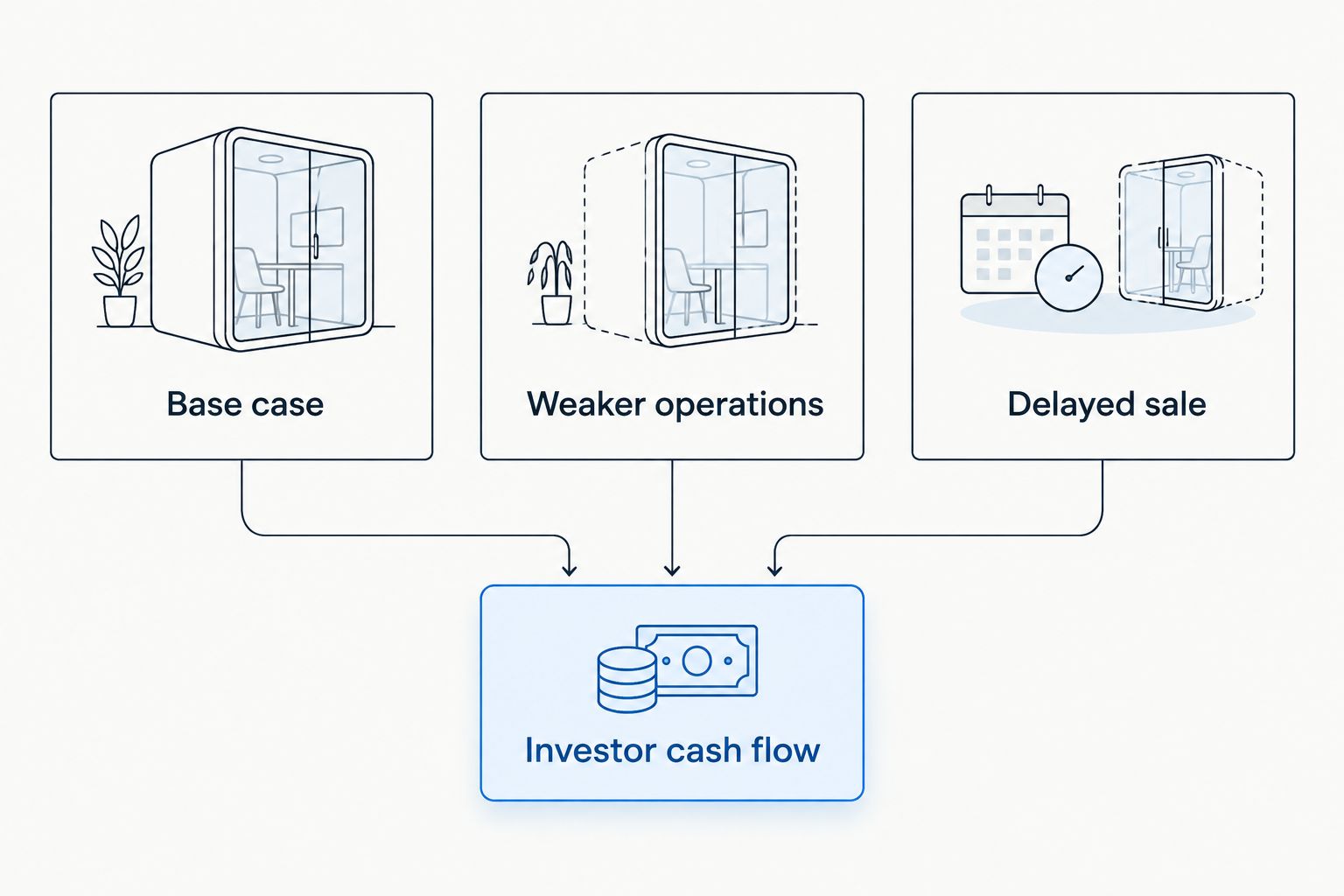
Request 3 scenarios: the sponsor's base case, weaker operations, and a delayed sale. These are comparison exercises, not predictions. Keep the underlying assumptions consistent when assessing different compensation structures.
- Base case: Identify every sponsor payment and the investor cash remaining after expenses, debt obligations, and reserves.
- Weaker operations: Determine which charges continue, which accrue, and whether distributions stop before sponsor compensation does.
- Delayed sale: Examine the effect of additional operating periods, debt maturity, recurring charges, and postponed return of capital.
Ask the sponsor to explain the assumptions rather than simply sending another projected return. A model is useful when you can follow the money. It is not proof that the projected outcome will occur.
Why real estate syndication fee comparisons vary
Different business plans involve different work. That does not make every charge reasonable; it means you need an explanation tied to the investment rather than a universal fee ranking.
- Property operations: An occupied property and a property requiring extensive leasing involve different operating tasks.
- Improvement work: Renovation or redevelopment adds construction oversight and project expenses to investigate.
- Debt transactions: Financing and refinancing introduce separate work, obligations, and potential compensation.
- Ownership period: Recurring charges continue according to the agreement, making timing relevant to total compensation.
- Affiliated providers: Related-party arrangements require clear disclosure of recipients, services, and conflicts.
- Distribution design: Preferred returns, catch-ups, and profit-sharing provisions change how results are divided.
For a 2026 decision, ask what each charge buys and how that service is documented. Do not accept complexity as an explanation by itself. A sponsor should be able to describe the arrangement in ordinary language.
Is a lower-fee real estate syndication always better?
A lower-fee real estate syndication is not automatically a better investment. Lower compensation leaves more cash available only when the other economics are comparable. It does not resolve weak underwriting, unfavorable debt terms, execution problems, or an unsuitable ownership period.
Compare 2 offerings using the same fee categories and scenario questions before ranking them. The practical advantage is consistency; the limitation is that different properties and business plans still prevent a perfect like-for-like comparison. State those differences instead of forcing a false ranking.
What should you ask when fees are unclear?
Ask for a written reconciliation between the offering documents and the financial model. Identify the unclear charge, its recipient, its calculation base, and its treatment in projected investor cash flow. Request clarification of any discrepancy before committing capital.
Use the first-deal checklist for physicians to keep compensation review within the wider investment decision. Fees are one part of diligence, not a substitute for reviewing the property, sponsor, debt, and legal terms.
Protect your liquidity before evaluating projected income
Private real estate investments can involve loss of principal, limited transfer rights, and distributions that are not assured. A projected payment schedule is not dependable funding for tuition, taxes, practice expenses, or another obligation with a fixed due date.
SEC Investor.gov guidance on private placements explains risks including illiquidity and limited disclosure compared with registered offerings. Use that guidance as background for your 2026 review, then examine the specific offering documents. Accredited-investor status does not make a particular investment suitable for your circumstances.
Keep investment and tax questions separate. Ask your own legal and tax advisers to evaluate the agreement and its consequences; fee descriptions alone do not establish deductibility or tax savings. This article provides general education, not individualized investment, legal, or tax advice.
Turn the comparison into a qualified conversation
Before discussing a specific opportunity with Timberview Capital, prepare your completed fee sheet, unresolved questions, liquidity needs, and reasons for considering private investments. The network's stated focus includes real estate and alternative asset opportunities for physicians and high-earning professionals. That focus does not replace diligence on an individual deal.
When you are ready for that conversation, use the existing Invest Alongside Us form as the next step. Bring questions that require specific answers: who receives compensation, how it is calculated, and what happens when performance falls short. A useful conversation clarifies the decision; it does not require an immediate commitment.
FAQ
What fees should I compare in a real estate syndication?
Compare all disclosed acquisition, management, financing, construction, sale, and profit-sharing compensation. Establish the recipient, calculation base, payment timing, and treatment in projected investor cash flow for each applicable charge.
Is a preferred return a guaranteed payment?
A preferred return is not an assured payment. It describes a contractual distribution priority, and actual payments depend on the agreement and available funds.
Is the sponsor’s promote the same as an asset management fee?
The promote is not the same as an asset management fee. The promote allocates profits under the distribution rules, while an asset management fee compensates investment oversight according to its contractual terms.
Can sponsor fees continue if investors receive no distributions?
Sponsor fees can continue without investor distributions if the agreement permits them. Check which charges remain payable, which accrue, and where those obligations rank in the payment sequence.
How do I know whether projected returns include every fee?
Ask for a reconciliation of the financial model with the offering documents. Confirm that investor-level projections account for all applicable charges and the complete distribution waterfall.
Should I choose the syndication with the lowest fees?
Do not choose a syndication on fees alone. Compare compensation alongside underwriting, debt obligations, execution requirements, liquidity restrictions, and possible loss of principal.
What should a physician ask before committing capital?
Ask how compensation changes when operations weaken or the sale is delayed. Also establish whether the investment’s liquidity restrictions fit your personal obligations and obtain independent professional advice on the documents.
One last thing
Ask this before discussing the projected return: Which sponsor payments continue if I receive no distributions? Then request the agreement provisions supporting the answer. That question connects compensation, liquidity, and incentives without assuming that any fee is inherently good or bad.
At Timberview Capital, we invest alongside members and share deals we underwrite for ourselves. If you want a peer network for walking fee structures before you commit, apply to join the network. You can also review current offerings when you are ready to compare live opportunities.
For educational purposes only. Not an offer to buy or sell securities.
Related guides