 TIMBERVIEW CAPITAL
Oil & Gas Investment Opportunity: Iron Horse Energy Fund III
A $50 million target diversified upstream oil and gas fund that directly acquires non-operated working interests in newly drilled U.S. oil and gas wells, across the Permian, Bakken, Eagle Ford, Niobrara and Anadarko basins.
Open Closes when full or on November 30, 2026, whichever comes first.
Iron Horse Energy Fund III
- $50MTarget fund size
- $100,000Minimum investment
- ~40Targeted newly drilled wells across multiple operators and basins
- 5 basinsPermian, Bakken, Eagle Ford, Niobrara & Anadarko
- ~90%Est. Year 1 K-1 tax deduction
- MonthlyProjected distributions, once commenced
- ~2.5 yearsEstimated return of capital
- 7–10 yearsEstimated hold period
All figures shown are targets or projections and are not guarantees of future results.
How the fund invests
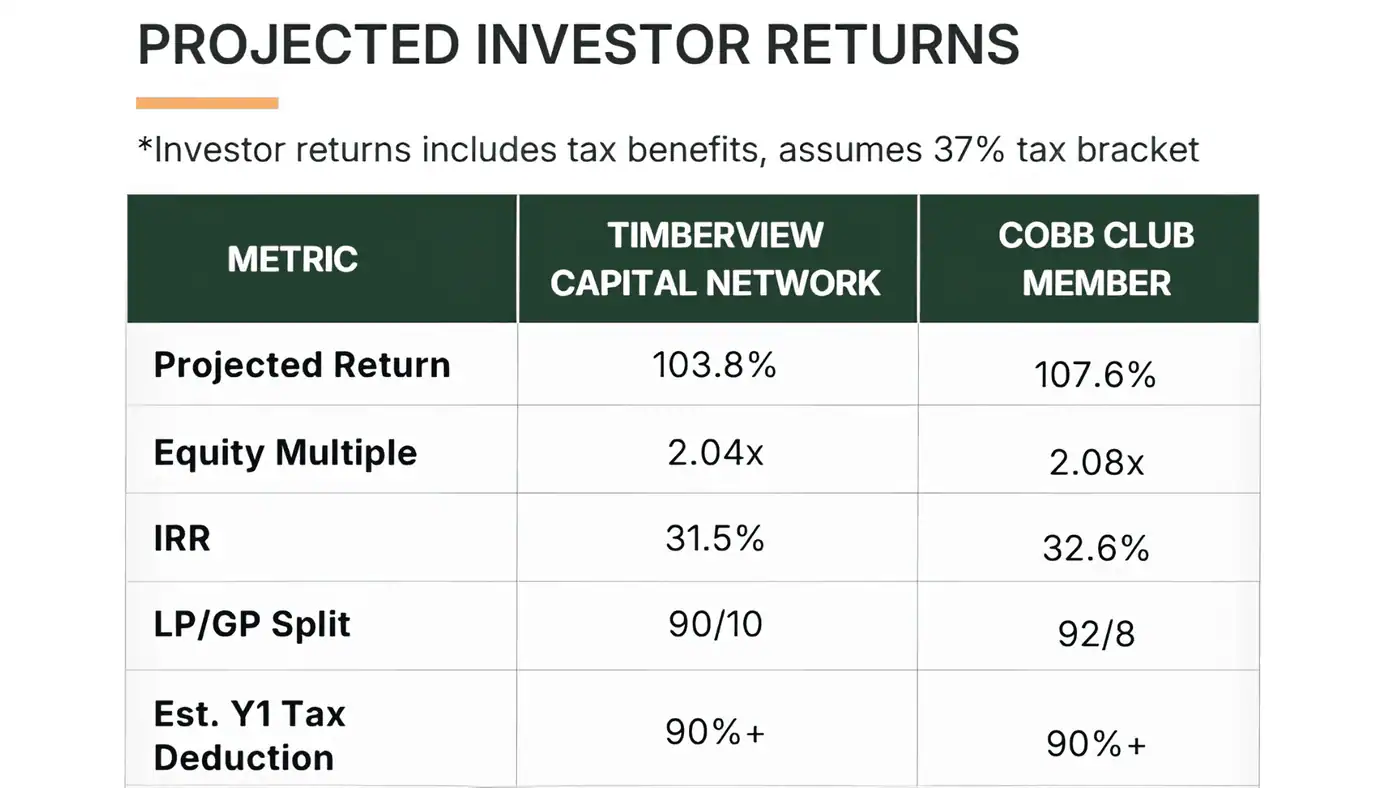
Permian, Bakken, Eagle Ford, Niobrara & Anadarko basinsCobb Club members receive a 92/8 Investor / Fund Manager split, compared with 90/10 for the Timberview Capital Network. The current model projects an 18.5% IRR and 1.74x equity multiple for Cobb Club members, compared with 17.6% IRR and 1.71x equity multiple for the Timberview Capital Network.
Timberview Capital presents Iron Horse Energy Fund III, a $50 million target diversified upstream oil and gas fund. The current model estimates approximately $90,000 in first-year tax deductions on a $100,000 Timberview investment. Depending on individual circumstances, qualifying deductions may offset active income, including W-2 income.
Iron Horse Energy Fund III directly acquires non-operated working interests in newly drilled U.S. oil and gas wells. Through Timberview, investors gain exposure to this diversified portfolio. The Fund intends to target opportunities across the Permian, Bakken, Eagle Ford, Niobrara, and Anadarko basins.
Returns are expected to come primarily from oil and gas production, with projected monthly distributions once commenced.


Key Highlights:
- Offering Closes: When full or on November 30, 2026, whichever comes first.
- Large First-Year Tax Deduction: A $100,000 Timberview investment is currently modeled to generate approximately $90,000 in 2026 tax deductions. Depending on individual circumstances, qualifying deductions may offset active income, including W-2 income.
- Monthly Cash Flow Potential: Distributions are projected to be paid monthly from production revenue once they begin.
- Diversified Well Portfolio: Targeting approximately 40 newly drilled wells across multiple operators, basins, and geologies. Potential operators may include EOG Resources, Continental Resources, ConocoPhillips, Devon Energy, and others.
- Conservative Price Assumptions: The fund was modeled at $60 WTI oil, with an estimated $40 breakeven.
- Experienced Sponsor: The team has completed 180+ drilling programs, 1,200+ wells, and 180M+ barrels for 1,100 investors. Fewer than 1% of wells across its career failed to produce commercially.
- Fund I Track Record: Fund I closed $31.4MM in total capital commitments and drilled 40 wells across 3 basins with 10 operators. It delivered a 95.6% actual Year 1 K-1 benefit and made its first cash distribution on May 1, 2026, 5 months after closing.
Potential tax benefits, and the risks
Qualifying intangible drilling costs may generally be deductible in the year incurred. Certain qualifying tangible drilling equipment may be eligible for 100% bonus depreciation under current law, and up to 15% of qualifying gross production income may be eligible for percentage depletion.
Tax treatment depends on each investor’s individual circumstances. Consult your own tax advisor regarding eligibility and use of deductions.
The Fund targets U.S.-based oil and gas assets. While the wells do not depend on Middle Eastern operations, returns remain exposed to global commodity prices and geopolitical events that can affect oil and natural gas markets.
Oil and Gas Investments for Accredited Investors
If you have been looking at oil and gas investment opportunities, you have probably noticed that most are open only to accredited investors. We started as a small group of physicians investing together, so here is the explanation we would want from a colleague: what the label means, how these deals are structured, what to ask, and what can go wrong.
What “accredited investor” means
It is an SEC definition, not a credential. An individual can generally qualify by meeting one of these tests:
- Income above $200,000 in each of the last two years (or joint income with a spouse above $300,000), with the expectation of the same this year
- Net worth above $1 million, alone or with a spouse, not counting your primary residence
- Holding a Series 7, 65 or 82 license in good standing
Certain entities can qualify too, such as one with more than $5 million in assets that was not formed just to make the investment. Meeting the definition gives you access; it is not a judgment that any particular investment is right for you. The SEC’s investor bulletin on accredited investors has the full definition.
Why oil and gas is usually offered only to accredited investors
Most private oil and gas funds are private placements. They are not registered with the SEC the way a public stock or mutual fund is, so the rules limit who can buy them.
Iron Horse Energy Fund III is offered only to verified accredited investors under Rule 506(c) of Regulation D. That rule lets a sponsor discuss an offering publicly, but it must take reasonable steps to verify that every investor is accredited. In practice that means sharing documents such as tax returns or recent bank and brokerage statements, or a letter from your CPA, attorney or registered investment adviser confirming your status.
Working interests vs. royalty interests, in plain terms
A working interest is a share of the well itself. The owner pays its share of the cost to drill, complete and operate the well, and receives its share of the revenue from what the well produces. A non-operated working interest is the same economic stake without running day-to-day operations: a professional operator does the drilling and the field work.
A royalty interest is a share of production revenue without paying drilling or operating costs, and without a say in how the well is run.
If an analogy helps: a working interest is like being a partner in a practice, sharing both the overhead and the collections. A royalty is closer to a licensing fee, a slice of the top line with none of the overhead. Iron Horse Energy Fund III acquires non-operated working interests in newly drilled U.S. oil and gas wells.
Questions to ask before you invest
- Who operates the wells, and what is their track record? Ask which operators are drilling, how long they have worked in these basins, and how the sponsor chooses them.
- How diversified is it? Any single well can disappoint. Spreading capital across many wells, operators and basins limits how much one of them matters, though it does not remove risk.
- Can I leave this money alone for years? Private placements are illiquid. There is generally no public market for your interest, so plan on holding it for the full estimated hold period.
- How would the tax treatment work for me? Oil and gas has its own tax rules, but how they apply depends on your income, how you are paid, your state and the rest of your tax picture. Ask your own CPA before you commit, not after.
- How is the sponsor paid? Read the private placement memorandum for fees, the investor and manager split, and any conflicts of interest.
- What happens if oil prices fall? Ask what price assumptions the model uses and how the fund would handle a long stretch of low prices.
The risks, plainly
- Commodity prices: Oil and natural gas prices move with global supply, demand and geopolitical events, and the revenue from every well moves with them.
- Dry holes and weak wells: Some wells never produce commercially, and others produce less than expected. Output from a well also generally declines over time.
- Illiquidity: You generally cannot sell a private placement interest quickly, and you should expect to stay in for the life of the fund.
- Reliance on operators: As a non-operated owner, the fund depends on third-party operators for drilling and day-to-day decisions.
- Tax and regulatory change: Tax law and energy regulation can change, and the treatment you expect may not apply to your situation.
- Loss of principal: As with any investment, you can lose some or all of the money you put in.
Our bottom line, one physician to another: understand what you own, size it so a disappointing outcome would not change your life, and get your CPA’s view first. Read the private placement memorandum, ask every question above, and if an answer does not make sense, it is fine to pass.
Learn more about the fund
 ▶Iron Horse Energy Fund III Update Webinar
 ▶Iron Horse Energy Fund III Update
 ▶Iron Horse Energy Fund III Launch Webinar
Is It Possible to Create a Self-Sustaining Investment?
How qualifying oil and gas investments may create significant deductions that could potentially offset W-2 income, and how Iron Horse is diversified across multiple wells, operators, and producing basins.
Watch the full recording →Iron Horse Energy Fund III with Courtney Moeller
Discover how this $50 million oil and gas fund is targeting monthly income, first-year tax benefits, and long-term returns through 40 newly drilled wells across major U.S. energy basins.
See offering webinars →Oil and gas investing: common questions
What is the minimum investment?
$100,000.
What does Iron Horse Energy Fund III invest in?
The Fund directly acquires non-operated working interests in newly drilled U.S. oil and gas wells. It is targeting approximately 40 newly drilled wells across multiple operators, basins, and geologies in the Permian, Bakken, Eagle Ford, Niobrara, and Anadarko basins. Potential operators may include EOG Resources, Continental Resources, ConocoPhillips, Devon Energy, and others.
How long is the expected hold period?
The estimated hold period is 7–10 years.
How are distributions paid?
Returns are expected to come primarily from oil and gas production. Distributions are projected to be paid monthly from production revenue once they begin.
What are the potential tax benefits?
A $100,000 Timberview investment is currently modeled to generate approximately $90,000 in 2026 tax deductions. Depending on individual circumstances, qualifying deductions may offset active income, including W-2 income. Tax treatment depends on each investor’s individual circumstances; consult your own tax advisor regarding eligibility and use of deductions.
Who can invest?
Offers are made only to verified accredited investors pursuant to Rule 506(c) of Regulation D, through a private placement memorandum and related offering documents. An individual can generally qualify as an accredited investor with income exceeding $200,000 (or joint income with a spouse of more than $300,000) in each of the last two years with the expectation of the same this year, or a net worth exceeding $1 million excluding the primary residence, or by holding in good standing a Series 7, 65 or 82 license. For more information, see this bulletin from the SEC.
What are oil and gas accredited investments?
They are private oil and gas offerings, such as funds that own interests in wells, that are open only to accredited investors because they are sold as private placements rather than registered public securities. Iron Horse Energy Fund III is one example: it is offered only to verified accredited investors under Rule 506(c) of Regulation D.
How do I verify that I am an accredited investor?
Under Rule 506(c), the sponsor has to take reasonable steps to verify your status. That usually means providing documents such as tax returns or recent bank and brokerage statements, or a letter from your CPA, attorney or registered investment adviser.
What is the difference between a working interest and a royalty interest?
A working interest owner pays a share of the costs to drill and operate a well and receives a share of its revenue. A non-operated working interest does the same without running day-to-day operations. A royalty interest receives a share of production revenue without paying drilling or operating costs. Iron Horse Energy Fund III acquires non-operated working interests.
Is oil and gas investing a good fit for physicians?
That depends on you, not your specialty. Oil and gas is illiquid, depends on commodity prices, and carries the risk that wells underperform. Before investing, make sure you are comfortable not touching the money for years, understand who operates the wells, and ask your own CPA how the tax treatment would apply to your situation.
When does the offering close?
When full or on November 30, 2026, whichever comes first.
Where can I see Timberview’s past investments?
Closed and past offerings, including earlier oil & gas investments, are listed in our Historical Portfolio.
Ready to Review the Opportunity?
Explore Iron Horse Energy Fund III, review the investment details, and access the offering documents.
See Portal Documents New to Timberview Capital? Apply to Join the Network. Membership is by application.