 TIMBERVIEW CAPITAL
Self Storage Investing for Physicians
How self storage works as a real estate investment, what we look for in a storage sponsor before we bring a deal to the network, and the self storage offering available to members right now: Stor It 2, a 423-unit climate-controlled conversion in Greece, New York.
Open Stor It 2 is available through the Timberview Capital Network.
Stor It 2
Greece, New York · Greater Rochester market
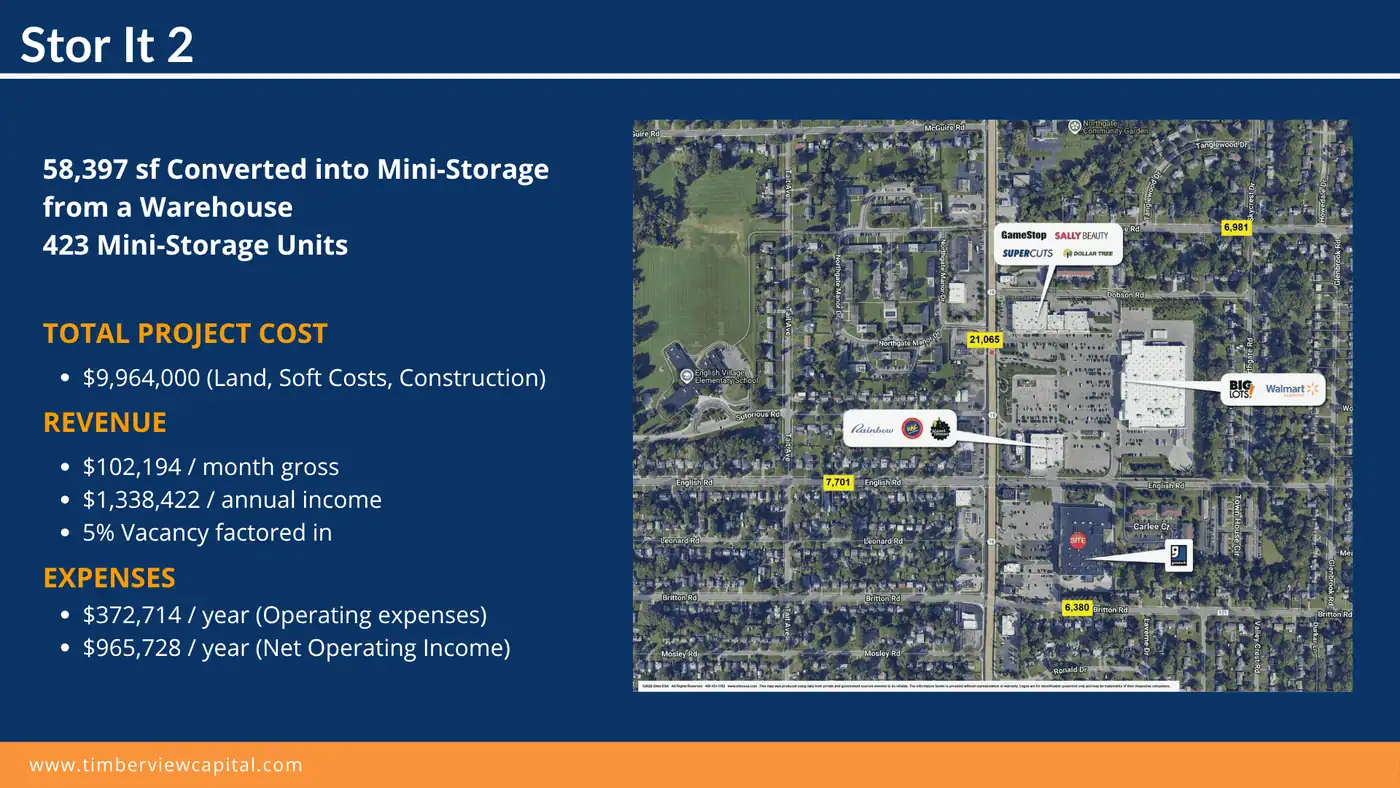
Stor It 2 site summary and site map.
- 423Planned climate-controlled storage units
- 58,397 sq ftPlanned storage space
- About 90 daysEstimated conversion period after acquisition
- $150,000Minimum investment through Timberview
See the offering documents for full terms.
Cobb Club members are projected to receive a higher preferred return at every investment level. The projections are 23% at $150,000, 25% at $250,000, and 27% at $500,000, compared with 21%, 23%, and 25% for the Timberview Capital Network.
Stor It 2 is a redevelopment investment in Greece, New York, in the greater Rochester market. The plan is to convert underutilized space inside an existing commercial property into a modern climate-controlled self storage facility, with 58,397 square feet of storage space and 423 storage units.
The project uses the existing building shell instead of building from the ground up. This is expected to shorten construction and speed up the path to operations; the estimated conversion period is about 90 days after acquisition. The property also has existing commercial uses alongside the planned storage operation.
The site sits on Dewey Avenue, with about 20,000 vehicles passing daily, next to a Walmart Supercenter. More than 200,000 residents live within a 5-mile radius.
The sponsor team brings more than 55 years of real estate experience. It has developed and redeveloped 12 to 14 shopping centers, negotiated more than 70 commercial leases, and developed and sold more than 1,000 self storage units. The facility is planned to be managed by White Label Storage, which manages more than 200 self storage facilities nationwide and was ranked #6 in the U.S. on Inside Self-Storage’s 2025 Top Operators list.
Timberview members have invested in self storage before. You can see past storage offerings in our Historical Portfolio.
Key Highlights:
- Adaptive Reuse Strategy: The plan uses an existing commercial building instead of ground-up construction, with an estimated 90-day conversion period after acquisition.
- Multiple Sources of Property Income: Existing commercial uses provide income alongside the planned self-storage operation.
- Short Projected Hold: The estimated investment term is 12 to 24 months, with a targeted refinance in 6 months to 1 year.
- Strong Local Demand Drivers: The site is on a high-traffic corridor next to a Walmart Supercenter, with over 200,000 residents within 5 miles.
- Experienced Sponsor: The team brings more than 55 years of real estate experience. It has developed and redeveloped 12–14 shopping centers, negotiated 70+ commercial leases, and developed and sold 1,000+ self-storage units.
- Professional Management Partner: White Label Storage manages 200+ self-storage facilities nationwide and was ranked #6 in the U.S. on Inside Self-Storage’s 2025 Top Operators list.
What self storage investing actually means
Most of us have rented a storage unit at some point: during a residency move, between houses, or when a parent downsized. Few of us thought of the building itself as an investment. Self storage is a type of commercial real estate, and it works a little differently from apartments or offices.
A storage facility rents space, not living space. Tenants usually sign short, month-to-month agreements, pay for a unit sized to what they need, and move on when their life changes. There are no kitchens to renovate and far fewer maintenance calls. Much of the work is operations: pricing, marketing, keeping the property clean and secure, and keeping units leased.
In the kind of deal we bring to the network, you are not the operator. A sponsor finds the property, arranges the financing, runs the business plan, and hires a professional management company. You invest passively as a limited partner, alongside other investors, and receive regular reporting.
For more on how passive, lease-driven real estate fits a busy clinician’s schedule, see our article on triple net leases and passive investing.
What drives demand for self storage
Storage demand tends to follow life events: moving, marriage, a new baby, divorce, downsizing, a death in the family, or a small business that has outgrown the garage. Those things happen in good economies and bad ones, which is part of why investors look at the asset class.
Short rental terms cut both ways. A facility can adjust its rates to the market fairly quickly, but tenants can also leave quickly, so occupancy depends on steady local demand and good management.
Location matters a great deal. Most customers rent close to home, so a facility’s trade area is usually a few miles. Visibility, traffic, access and the amount of competing storage nearby all shape how a property performs.
There are two common ways to add storage to a market. One is ground-up construction on raw land. The other is conversion: turning an existing building, such as a warehouse or underused retail space, into climate-controlled units. A conversion can be faster because the shell is already standing, but it brings its own questions about the building’s condition, layout and permits.
What we look at before a storage deal reaches the network
Every offering we bring to members is vetted on four things: the team, the market, the location, and the business plan. Here is what that means for a self storage deal.
The team
How long the sponsor has developed and operated storage, how many projects it has completed and sold, and who will manage the facility day to day. We look closely at the management company’s scale and systems, because storage is an operations business.
The market
Population and household trends in the trade area, how much storage already exists per resident, and what new supply is planned nearby. A good facility in an oversupplied market can still struggle to lease up.
The location
Visibility from the road, traffic counts, access, nearby retail anchors, and how many people live within a short drive. Storage customers rarely travel far, so the immediate neighborhood matters.
The business plan
The construction or conversion scope, the budget, the timeline, how the project is financed, and how conservative the lease-up assumptions are. We pay close attention to the debt and to how much room there is if things take longer than expected.
Questions a physician investor should ask any self storage sponsor:
- How many storage projects have you completed, and how did the ones that struggled turn out?
- Who manages the facility, and how many properties do they run?
- How much competing storage is within a few miles, and what is planned?
- For a conversion, what condition is the building in, and what permits are needed?
- How is the project financed, and what happens if lease-up is slow?
- How much of your own capital is in the deal?
- What fees does the sponsor earn, and when?
- How long should I expect my money to be tied up?
The risks of self storage investing
All investments involve risk, including loss of principal. With a self storage development or conversion, these are the ones we would want to understand first:
- Lease-up. A new or converted facility starts empty. Filling units can take longer than planned, especially if competitors cut rates.
- Local supply. Storage is relatively quick to build, so new facilities nearby can change the picture.
- Construction and permits. Conversions can uncover building issues, and approvals or contractors can delay the timeline or raise the budget.
- Interest rates and debt. Most projects use a loan. Higher rates or tighter lending can strain a project or change the sponsor’s plan.
- Operations. Pricing, marketing and staffing drive results. A weaker operator can mean weaker occupancy.
- Liquidity. This is a private placement. You generally cannot sell your interest early, and timelines can run longer than the estimate.
Watch the offering webinars
 ▶
 ▶
Self storage investing: common questions
What is self storage investing?
It means owning part of a facility that rents storage units to households and small businesses. Through a private offering, you invest passively as a limited partner while the sponsor builds or converts, leases and operates the property.
What is a self storage conversion?
A conversion turns an existing building, such as a warehouse or underused commercial space, into storage units instead of building on raw land. Because the shell already exists, a conversion can move faster, but it depends on the building’s condition, layout and approvals.
Do I have to deal with tenants or the facility?
No. The sponsor and its management company handle leasing, pricing, marketing and day-to-day operations. For Stor It 2, the planned manager is White Label Storage. Your role is to review the offering, decide whether to invest, and read the updates.
Who can invest?
Offers are made only to verified accredited investors pursuant to Rule 506(c) of Regulation D, through a private placement memorandum and related offering documents. An individual can generally qualify as an accredited investor with income exceeding $200,000 (or joint income with a spouse of more than $300,000) in each of the last two years with the expectation of the same this year, or a net worth exceeding $1 million excluding the primary residence, or by holding in good standing a Series 7, 65 or 82 license. For more information, see this bulletin from the SEC.
What is the minimum investment for Stor It 2?
$150,000 through the Timberview Capital Network. The offering documents describe the full terms.
How long is my money tied up?
The estimated investment term for Stor It 2 is 12 to 24 months, as described in the offering documents. Private placements are illiquid, you generally cannot withdraw early, and actual timing can run longer than the estimate.
Can I invest through a retirement account?
Some investors use a self-directed IRA or Solo 401(k). Whether that works for a given offering depends on the offering documents and your custodian, so talk with your own tax and financial advisors first.
How does Timberview choose self storage sponsors?
We vet every offering on the team, the market, the location, and the business plan, with close attention to the sponsor’s track record, the management company, and how the project is financed. We also encourage every member to do their own due diligence.
Invest Alongside Other Physicians
Members of the Timberview Capital Network get access to vetted self storage offerings like Stor It 2, along with webinars and education from physicians who have been doing this for years.
Apply to Join the Network Already a member? Review Stor It 2. Membership is by application.