 TIMBERVIEW CAPITAL

As physicians, we are trained to read the fine print before we trust a plan. Commercial real estate is no different: the loan terms often matter more than the projection on page one.
In commercial real estate investing, check when the loan matures, how payments change, what the lender can require, and whether the property can repay the debt without a favorable refinancing. A projected distribution is not dependable income when the loan allows cash restrictions, requires additional reserves, or leaves a large balance due at maturity.
- Commercial real estate investing requires checking repayment terms, not just the quoted interest rate.
- The Timberview Capital Network helps accredited physicians explore private real estate and alternative investments.
- Ask the sponsor to show debt service, maturity obligations, covenant requirements, and downside assumptions together.
- Private real estate investments carry possible loss of principal, illiquidity, and distributions that are not assured.
Timberview Capital is for accredited physicians evaluating private real estate and alternative investments. Use the loan review below to prepare specific questions before an investor conversation.
What loan terms should you check in commercial real estate investing?
For a 2026 investment review, read the debt terms alongside the operating forecast. The interest rate describes only part of the obligation; repayment timing and lender rights determine what happens when the property misses its plan.
Ask for the executed loan agreement when available, a current debt summary, and an explanation of any differences between those documents and the investor presentation. A term sheet describes proposed terms, not necessarily the final agreement.
| Loan structure | Best for evaluating | Main benefit | Main limitation |
|---|---|---|---|
| Fixed-rate debt | A plan that prioritizes predictable interest expense | The contractual rate stays fixed during its stated period | Maturity and prepayment restrictions still matter |
| Floating-rate debt | A plan that explicitly accounts for changing interest expense | The rate adjusts with its contractual benchmark | Payments can rise; protection depends on any hedge terms |
| Interest-only payments | A business plan that needs lower scheduled payments initially | Scheduled payments exclude principal during the interest-only period | The principal balance does not decline through those payments |
| Amortizing payments | A plan that includes scheduled principal reduction | Payments reduce the outstanding balance | Principal payments require cash as well as interest |
These features overlap. A loan can be fixed-rate and interest-only, or floating-rate and amortizing. Evaluate the complete loan structure, not a label.
Why this matters for a busy physician
Your clinical income does not make a property loan safer. If you invest passively, the sponsor makes financing decisions while your ability to exit depends on the investment documents and the availability of a permitted buyer or redemption arrangement.
Loan payments compete with operating expenses, repairs, reserves, and investor distributions. A property can produce rental income while distributing nothing to investors because the cash is needed elsewhere or the lender restricts payments.
Before committing in 2026, separate the property's operating story from its financing story. A credible renovation or leasing plan still needs enough time and cash to survive its debt obligations.
Fixed-rate debt: check the fixed period and exit restrictions
A fixed rate makes contractual interest expense more predictable during the fixed-rate period. It does not assure distributions, eliminate operating losses, or ensure that replacement financing will be available at maturity.
Ask whether the quoted rate applies through the entire loan term. Also check whether a transfer, sale, or early repayment triggers lender consent or an additional obligation under the agreement.
Prepayment provisions deserve attention even if you expect a long hold. A sponsor might want to sell earlier, replace expensive debt, or respond to a change in the business plan; restrictive terms can make that decision harder.
Best for: evaluating predictable interest expense. Trade-off: predictability is not the same as an inexpensive or unrestricted exit.
Floating-rate debt: check the benchmark and rate protection
A floating-rate loan generally calculates interest using a benchmark plus a contractual margin. A rate floor can prevent the payable rate from falling below a specified level, even when the benchmark declines.
A movement of 100 basis points equals 1 percentage point. When reviewing a 2026 floating-rate loan, ask the sponsor to show how a benchmark increase changes debt service and cash remaining after expenses, rather than describing the change only in basis points.
If the loan uses an interest-rate cap, check its strike rate, expiration, covered amount, and replacement obligations. A cap limits exposure under its contract; it does not remove principal repayment obligations or protect property income.
Best for: evaluating a plan that explicitly budgets for rate changes. Trade-off: protection can expire before the property is ready to refinance or sell.
Interest-only and amortizing debt: check what remains unpaid
Interest-only payments do not reduce principal through scheduled payments during that period. They can leave more current cash available than an otherwise comparable payment that includes principal, but that difference is not additional property operating income.
Amortization means scheduled payments reduce principal over time. The amortization schedule can extend beyond the loan's maturity, leaving a balloon payment: the remaining balance due when the loan ends.
Ask the sponsor to place the payment schedule beside the hold-period forecast. Identify when interest-only treatment ends, when principal payments begin, and how much debt remains at maturity.
Best for: distinguishing current cash flow from actual debt reduction. Trade-off: lower payments today can leave a larger repayment obligation later.
Why commercial property loan risk varies
The same headline rate can sit inside very different financing arrangements. For your 2026 review, focus on these drivers:
- Maturity timing: Debt that comes due before the operating plan is complete creates a repayment deadline before the intended exit.
- Rate exposure: A floating benchmark, contractual floor, and expiring hedge affect how interest expense changes.
- Principal schedule: Interest-only treatment and amortization determine whether scheduled payments reduce the balance.
- Covenant requirements: Financial tests, reporting duties, and reserve rules affect the borrower's obligations throughout the loan.
- Lender remedies: Cash restrictions, default provisions, and enforcement rights determine what the lender can do when requirements are missed.
- Refinancing assumptions: Future income, valuation, lender underwriting, and borrowing terms affect whether a replacement loan can repay the existing balance.
None of these replaces a property-level review. Financing risk sits alongside leasing, operating, construction, and market risks rather than canceling them out.
How do you review the loan before investing?
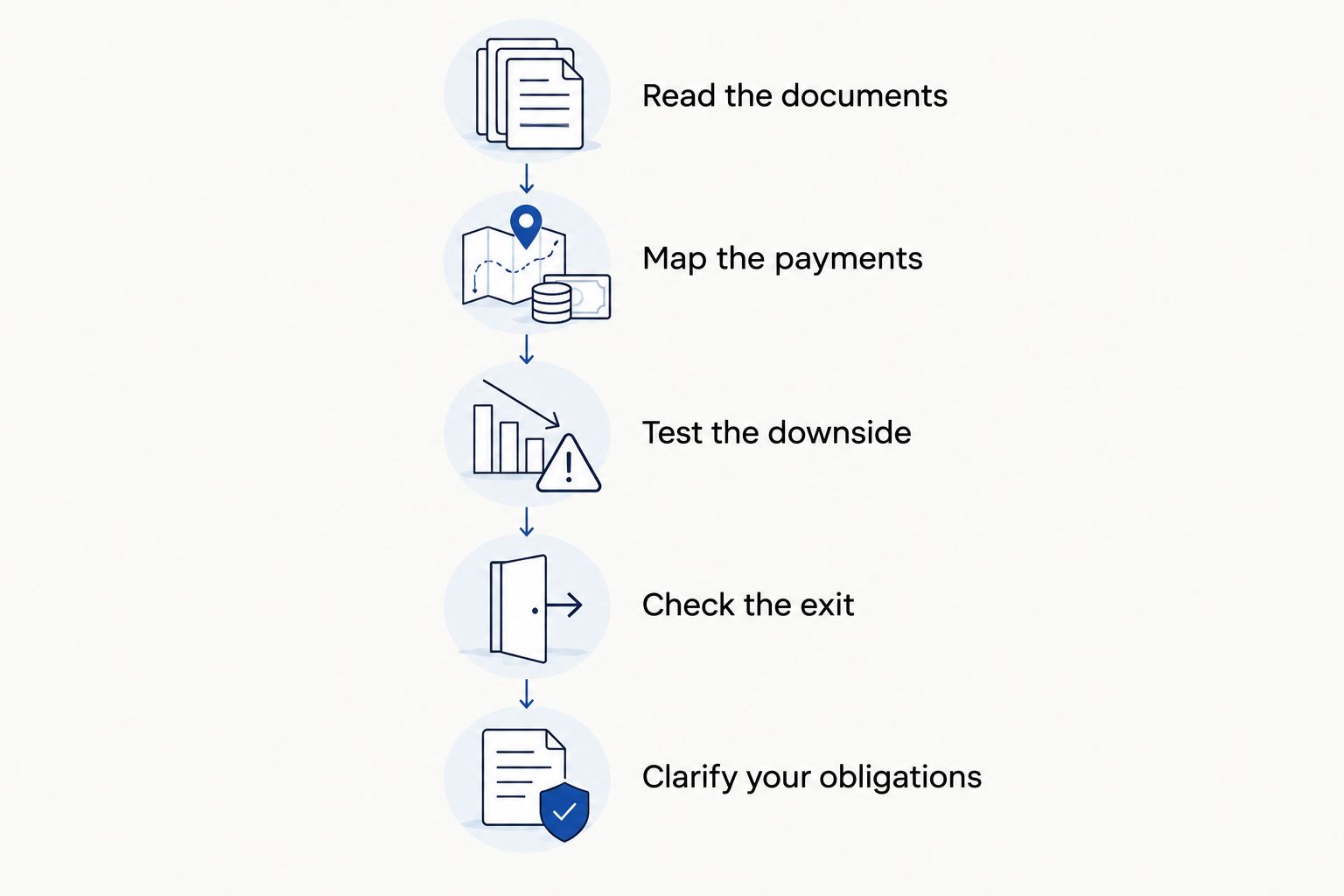
Use a document-led sequence. The goal is not to become the lender's lawyer; it is to identify the assumptions that need explanation from the sponsor and review by your own advisers.
- Read the documents. Compare the debt summary with the loan agreement or proposed term sheet. Ask which terms are final and which remain subject to negotiation or lender approval.
- Map the payments. Identify the rate calculation, interest-only period, amortization, maturity, and any required reserves. Keep scheduled debt payments separate from operating expenses.
- Test the downside. Ask for scenarios with weaker property income, higher applicable interest expense, and a delayed exit. Require the sponsor to identify the source of any additional cash needed.
- Check the exit. Review the remaining balance, extension conditions, prepayment provisions, and refinancing assumptions. Ask what happens if the lender declines an extension.
- Clarify your obligations. Read the investment agreement for capital calls, dilution, transfer restrictions, and distribution provisions. Do not assume the property's loan agreement answers every investor-level question.
A useful sponsor response points you to the controlling document and explains the consequence in plain language. If a material term remains unclear, resolve it before committing capital.
What does debt-service coverage actually tell you?
The debt-service coverage ratio, or DSCR, compares the income defined for the calculation with the debt payments defined for the same period. Property presentations commonly use net operating income divided by debt service, but the lender's contractual definitions control covenant compliance.
A DSCR of 1.0x means the defined income equals the defined debt service. It does not mean the investment has enough cash for every repair, reserve contribution, investor distribution, or unexpected expense.
Ask whether the presentation uses actual results or projected stabilized income. Also ask whether the debt-service calculation reflects interest-only payments, later amortizing payments, and the rate assumptions that apply to the loan.
For a 2026 review, avoid treating a single coverage ratio as a permanent safety margin. The numerator can fall as income weakens, and the denominator can rise when applicable rates or payment requirements change.
How does loan-to-value affect refinancing risk?
Loan-to-value, or LTV, compares the loan balance with the property's value. An LTV of 100% means the loan balance equals the value used in that calculation; it does not establish what a buyer will pay or what a future lender will accept.
Ask which valuation supports the reported ratio: an appraisal, acquisition value, or projected future value. A ratio based on a future stabilized valuation depends on assumptions that have not yet become results.
Refinancing also depends on income-based underwriting and lender terms, not just value. A property can have positive equity and still fail to qualify for enough replacement debt to repay its existing loan.
What happens if the loan cannot be refinanced?
The borrower still owes the contractual maturity obligation unless the lender agrees to a change or the documents provide an applicable extension right. Possible responses include a sale, additional equity, a negotiated modification, or another financing arrangement; none is assured.
Ask whether extensions are optional for the borrower or subject to lender discretion. Conditions can include financial tests, reserve funding, fees, and the absence of a default, depending on the agreement.
Then ask who supplies additional capital. A sponsor's willingness to contribute is different from a binding obligation, and an investor capital call is governed by the investment documents.
Loss of principal is possible. A refinancing plan should explain the failure case, not merely assume a future loan closes.
Questions to bring to an investor conversation
Bring the questions below to a Timberview Capital commercial real estate investing conversation. They focus the discussion on the specific opportunity rather than a general outlook for property markets.
- What event is supposed to repay the loan, and what happens if that event is delayed?
- Which covenant is most sensitive to weaker income or higher debt service?
- Under what conditions can the lender restrict distributions or require additional reserves?
- Does any guaranty or recourse provision create obligations relevant to investors, directly or through the investment entity?
- Which refinancing assumptions depend on higher valuations or better borrowing terms?
- Where do the documents explain capital calls and the consequences of not participating?
A nonrecourse label is not a substitute for reading the agreement. Exceptions, guaranties, entity structure, and investor obligations need document-specific legal review.
FAQ
What’s the most important loan term in commercial real estate investing?
Maturity is a critical starting point because it establishes when the outstanding debt must be repaid. Review it together with payment requirements, extension conditions, and the proposed repayment source rather than treating any term as sufficient alone.
Is fixed-rate debt safer than floating-rate debt?
Fixed-rate debt provides more predictable contractual interest expense during its fixed period, but it does not eliminate investment risk. Compare maturity, amortization, prepayment restrictions, and lender rights before deciding which structure fits the business plan.
Does an interest-only loan mean the investment earns more?
An interest-only loan does not increase the property’s operating income. It excludes scheduled principal repayment during the interest-only period, leaving the principal balance to be addressed later.
What does a DSCR of 1.0x mean?
A DSCR of 1.0x means the income defined for the calculation equals the debt service defined for that period. It does not establish that cash remains for investor distributions, unexpected repairs, or all required reserves.
Can a lender stop distributions to passive investors?
Loan agreements can restrict cash distributions when specified conditions apply. Ask the sponsor to identify the applicable provisions and explain how lender restrictions affect payments through the investment entity.
Can I lose my investment if a property cannot refinance?
You can lose some or all of your invested principal if the property cannot meet its obligations. Refinancing difficulties can also lead to delayed distributions, additional capital needs, or a sale under unfavorable conditions.
Should my adviser review a private real estate investment?
Your own legal, tax, and financial advisers should evaluate how a private real estate investment fits your circumstances. General education and sponsor explanations do not replace individualized advice or document-specific review.
One last thing
A loan extension is not the same as extra time you already control. Read every condition before counting an extension as part of the business plan, and ask what the sponsor will do if those conditions cannot be met.
At Timberview Capital, we invest alongside members and share deals we underwrite for ourselves. Bring your loan-term questions into a qualified conversation – apply to join the network. You can also explore our webinars for more education on commercial real estate structures.
For educational purposes only. Not an offer to buy or sell securities.
Related guides
- Alternative investments for accredited investors: choosing a fit
- How to compare real estate syndication companies
- Real estate investing for physicians: your first-deal checklist