 TIMBERVIEW CAPITAL

A polished deck can look ready for a signature. For busy professionals, the better first move is a short screen that protects your time and your capital.
Screen real estate investment opportunities by checking personal fit, sponsor history, property cash flow, debt terms, investor rights, and the assumptions behind the exit. Advance only when the documents explain both how you get paid and how you can lose money. For a busy physician evaluating a deal in 2026, the right first decision is whether the opportunity deserves deeper review – not whether the projected return looks attractive.
- Screen real estate investment opportunities for liquidity, sponsor accountability, debt risk, and documented cash flow before comparing projected returns.
- The Timberview Capital Network helps accredited physicians evaluate passive real estate investments without replacing independent review.
- Private real estate can lose principal, restrict withdrawals, and stop distributions.
- Ask what happens if occupancy falls, refinancing fails, or the property takes longer to sell.
Why this matters
A demanding clinical schedule makes a polished presentation useful, but presentation quality does not establish investment quality. You need a repeatable screen that separates a plausible business plan from assumptions you cannot verify.
Timberview Capital offers private real estate and alternative investment deal access for accredited investors, including physicians. Timberview Capital is best suited to accredited physicians seeking a network for evaluating passive real estate investments. A network can organize your search; it does not replace independent review of the sponsor, offering documents, and financial assumptions.
Use the following process to decide what deserves your time, what needs clarification, and what you should decline.
How do you screen real estate investment opportunities?
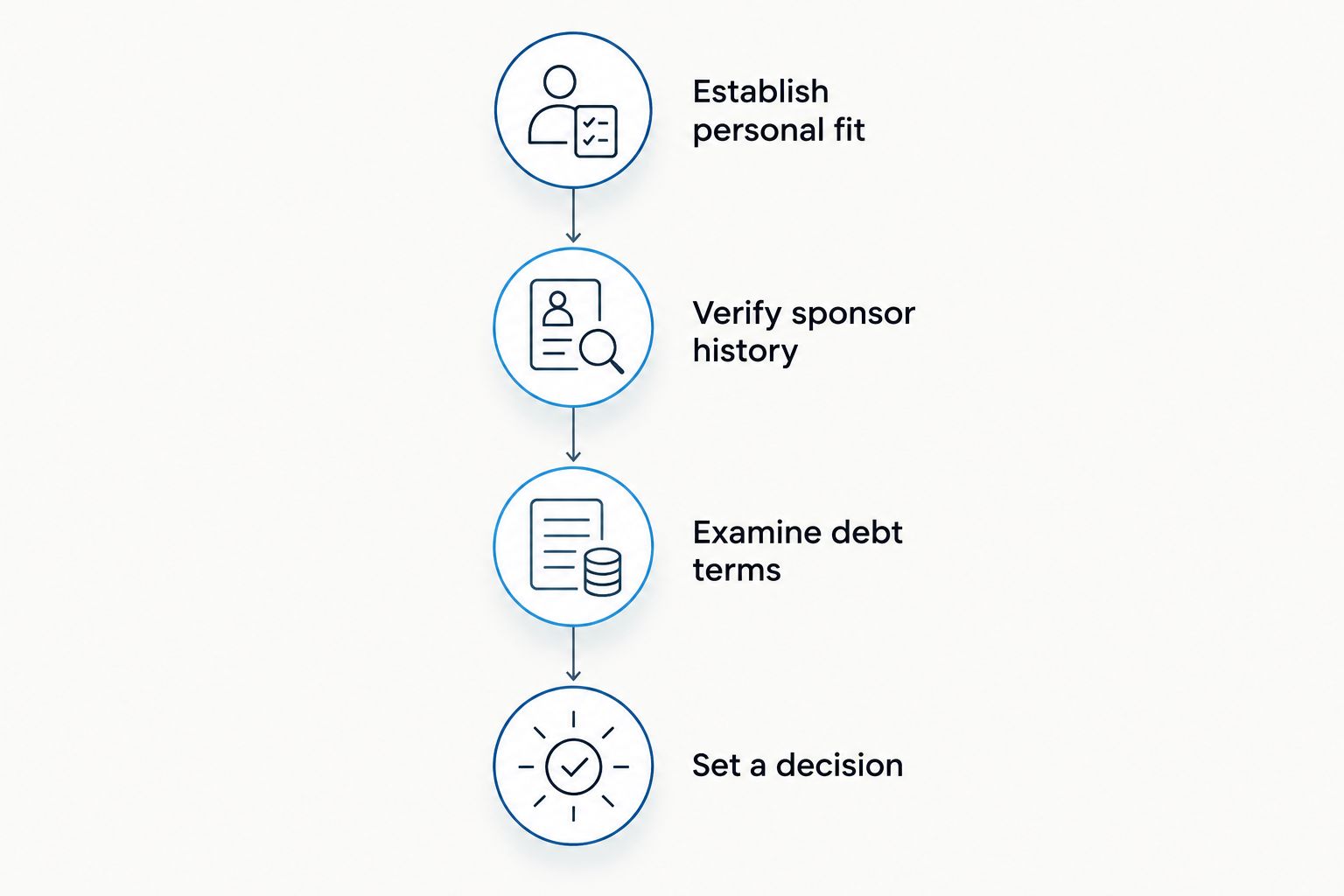
Follow these steps in order. Resolve basic suitability and document questions before spending time debating return projections.
1. Establish personal fit
Start with your household finances, not the property. Separate money committed to living expenses, taxes, emergencies, and foreseeable obligations from capital you can leave invested without a dependable withdrawal date.
Ask yourself:
- Can I tolerate losing the entire investment without disrupting essential plans?
- Can I hold the investment if the sale takes longer than projected?
- Am I relying on distributions to pay recurring bills?
- Would this investment concentrate too much of my wealth in one location, sponsor, or economic exposure?
A physician who already owns a practice building has different concentration concerns from a physician with no direct property holdings. An attractive property is not automatically a suitable allocation.
2. Verify sponsor history
The sponsor is the person or firm responsible for executing the business plan. Request an investment history that distinguishes completed investments from properties still held, and realized results from estimates.
Ask about deals that missed their original plans. What changed, how were investors informed, and what happened to investor capital? A successful sale alone does not explain whether returns came from property operations, additional borrowing, or favorable market conditions.
Check who performs asset management, who handles property operations, and whether those responsibilities depend on outside firms. Ask for references and corroborating documents rather than treating a biography as evidence.
3. Reconcile cash flow
Trace projected distributions back to the property's operating assumptions. For an occupied rental property, request the rent roll, historical operating statements, occupancy information, and the budget supporting the plan.
Compare actual collections with scheduled rent. Review property taxes, insurance, maintenance, management expenses, and planned improvements. Net operating income generally excludes financing costs, so it is not the same as cash available to investors.
Ask whether distributions depend on ongoing operations, borrowed funds, reserves, or returned capital. These sources have different implications even when the payment reaching your account looks identical.
4. Examine debt terms
Request the loan summary and confirm the interest structure, maturity, extension conditions, repayment requirements, and any guarantees. Determine whether the business plan requires refinancing before the property can be sold.
A fixed interest rate does not eliminate maturity risk. A floating interest rate introduces another variable into cash flow, and a rate cap has its own terms and expiration.
Ask what happens if refinancing produces less cash than expected or is unavailable. Identify who supplies additional capital, whether investors face a capital call, and what the governing documents say about investors who do not participate.
5. Read investor rights
Review the private placement memorandum, subscription agreement, operating agreement, and relevant financial materials together. A presentation summarizes the offering; it does not replace the documents governing your investment.
Find the provisions covering fees, distributions, transfers, voting, sponsor removal, conflicts of interest, and additional capital. Ask a qualified attorney to explain provisions you do not understand.
Pay particular attention to sponsor discretion. If the sponsor can change the timing of distributions, extend the investment, or enter related-party arrangements, understand the boundaries and required disclosures before subscribing.
6. Challenge the exit
An exit is the planned sale, refinancing, or other transaction used to return capital. Ask which assumptions drive the projected outcome and what happens when those assumptions become less favorable.
For income-producing property, a capitalization rate relates property income to value. Holding income constant, a higher exit capitalization rate implies a lower sale value. That relationship makes the sale assumption material, not a technical footnote.
Request scenarios with weaker occupancy, higher expenses, delayed improvements, and a later sale. A projection deserves attention only when you understand what breaks it.
7. Set a decision
End the initial screen with a clear result: advance, request evidence, or decline. Keep unresolved questions in writing and identify which answer would change your decision.
Do not treat a deadline as a substitute for understanding. If you cannot explain the investment's cash source, debt exposure, and loss scenario in plain language, stop before committing capital.
Which real estate approach fits your involvement level?
Compare the ownership structure before comparing projected outcomes. Direct ownership, a single-property syndication, and a pooled fund place different responsibilities and decisions in your hands.
| Approach | Best for | Main advantage | Main limitation |
|---|---|---|---|
| Direct ownership | Investors who want property-level control | You direct operating and sale decisions, subject to contracts and financing | You retain ownership responsibilities even when you hire management |
| Single-property syndication | Investors who want to evaluate a defined property and delegate operations | You can examine a specific asset and business plan before subscribing | Your investment depends on that property's results and the sponsor's execution |
| Pooled real estate fund | Investors comfortable delegating asset selection | The structure can hold multiple assets under one investment mandate | Your visibility and approval rights depend on the fund documents |
None of these structures assures diversification, liquidity, or income. A fund concentrated in one property type or region can still expose you to closely related risks.
For a 2026 comparison, judge the actual documents rather than the structure's label. “Passive” describes your operating role; it does not describe the investment's risk.
Why real estate investment opportunities vary
Different business plans produce different demands on cash, time, and sponsor execution. Compare these drivers before deciding whether two offerings belong in the same comparison:
- Property condition: A renovation plan depends on construction work, spending controls, and execution-not just existing rental income.
- Tenant demand: Occupancy, collections, lease expirations, and tenant concentration affect the reliability of property income.
- Financing: Interest terms, maturity dates, covenants, and refinancing requirements change the pressure on cash flow.
- Sponsor incentives: Fees, co-investment, and distribution priorities determine how the sponsor gets paid relative to investors.
- Ownership structure: Investor rights, transfer restrictions, and decision authority change what you can do when circumstances deteriorate.
- Exit assumptions: Sale timing and valuation assumptions affect the amount and timing of capital returned.
A higher projected return does not resolve weaknesses in these areas. It is an output of assumptions that still need examination.
What should you ask an investment network before joining?
Ask what the network does, what it does not do, and how it is compensated. Establish whether it introduces opportunities, evaluates sponsors, participates in investments, or performs another role. Do not assume those activities are interchangeable.
For a conversation with Timberview Capital, bring your intended holding period, liquidity needs, existing property exposure, and questions about sponsor selection. Ask how any opportunity is evaluated and which documents support that assessment; do not assume a process or service that has not been explained.
Also ask who receives compensation when you invest and whether related parties participate. Request the relevant disclosures in writing. Community access and educational value are useful, but neither substitutes for understanding incentives.
Use the first conversation to test clarity, not to negotiate yourself into a deal. A useful answer identifies the responsible party, supporting evidence, and limits of what is known.
Start an investor conversation
Discuss your goals, liquidity needs, and questions about evaluating private investment opportunities.
Do you need to be accredited to invest?
Accreditation requirements depend on the offering exemption. Being a physician does not automatically make you an accredited investor, and accreditation does not establish that an investment is suitable.
Under the SEC's individual financial criteria applicable in 2026, an individual can qualify with net worth exceeding $1 million, excluding the primary residence under the rule's calculation. An individual can also qualify through annual income exceeding $200,000, or joint income exceeding $300,000 with a spouse or spousal equivalent, in each of the prior two years, with a reasonable expectation of reaching the same income level in the current year.
Other qualification routes exist, including specified professional credentials. The SEC's Accredited Investors guidance and Regulation D, Rule 501(a), provide the governing criteria; confirm which route and verification process apply to the offering.
Accreditation is an eligibility screen. It is not SEC approval of the sponsor, property, or projected results.
How do you judge a projected distribution?
A projected distribution is an estimate, not a payment obligation. Ask when distributions are expected to begin, what funds them, and who has authority to reduce or suspend them.
A preferred return describes a priority in the distribution arrangement; it does not assure that enough cash will exist to pay it. Read how unpaid amounts, sponsor participation, and return of capital interact in the actual agreement.
For your 2026 household plan, do not treat projected private real estate distributions like salary. Keep essential obligations independent of payments that can change or stop.
Which tax questions belong in the initial screen?
Ask what ownership entity you would hold, which tax documents you should expect, and whether the structure creates filing obligations outside your home state. Bring the answers to your CPA before investing.
Do not assume depreciation or a rental loss will offset your clinical income. IRS Publication 925 explains passive activity limitations and the requirements associated with real estate professional status; applying those rules depends on your circumstances and participation.
For a 2026 investment decision, evaluate the underlying economics separately from any proposed tax treatment. Tax benefits do not repair a weak investment, and tax outcomes are not assured.
FAQ
What’s the first thing I should check in a real estate investment opportunity?
Check whether you can tolerate the investment’s loss potential and withdrawal restrictions. Resolve personal suitability before comparing projected returns or property features.
How do I check a real estate sponsor’s track record?
Request a history that separates completed investments from current holdings and realized results from projections. Ask about unsuccessful deals, investor communications, and documents that corroborate the account.
Is a preferred return guaranteed income?
A preferred return is not assured income. It describes a distribution priority under the agreement, and payment still depends on available cash and the governing terms.
Can I sell a private real estate investment whenever I want?
Do not assume you can sell a private real estate investment whenever you want. Transfer restrictions, approval requirements, and the absence of a ready buyer can prevent an exit when you need one.
Does being a physician make me an accredited investor?
Being a physician does not automatically make you an accredited investor. Qualification depends on applicable financial or other eligibility criteria, and the offering determines the required process.
What should I ask Timberview Capital before evaluating an opportunity?
Ask Timberview Capital about its role, compensation, sponsor evaluation, and the documents available for review. Explain your liquidity needs and existing investments so the conversation addresses fit rather than projections alone.
Can real estate losses automatically reduce my physician income taxes?
Real estate losses do not automatically reduce taxes on physician income. Passive activity limitations and other rules affect whether and when losses are deductible; review the specific investment with your CPA.
One last thing
Ask the sponsor to explain the downside without showing the return chart. What event would interrupt distributions, require additional capital, or force a sale on unfavorable terms?
Write that answer beside the investment thesis. If the opportunity still makes sense after that exercise-and the documents support the explanation-you have a reason to continue reviewing it, not a reason to skip review.
At Timberview Capital, we invest alongside members and share deals we underwrite for ourselves. If you want a structured place to screen opportunities with other busy professionals, apply to join the network. You can also explore our webinars or review current offerings.
For educational purposes only. Not an offer to buy or sell securities.
Related guides
- Alternative investments for accredited investors: choosing a fit
- How to compare real estate syndication companies
- Real estate investing for physicians: your first-deal checklist