 TIMBERVIEW CAPITAL
Multifamily Investing for Physicians
How apartment communities work as an investment, what we look for in a sponsor before we bring a deal to the network, and the multifamily offering available to members right now: Halston Waterleigh, a 354-unit, Class A apartment community in the Orlando MSA.
Open Halston Waterleigh is available through the Timberview Capital Network.
Halston Waterleigh
Horizon West / Winter Garden, Orlando MSA- 354Class A apartment units, built in 2021 by D.R. Horton
- Orlando MSAHorizon West / Winter Garden
- 7%Preferred return
- 18.80%–19.60%Target IRR
- 1.98x – 2.03xTarget equity multiple
- 4 yearsProjected hold period
- $100,000Minimum investment through Timberview
Targets and projections are estimates and may not be achieved. See the offering documents for full terms.
Cobb Club members may access exclusive Class B economics, including a 95/5 LP/GP split, 19.60% IRR, and 2.03x equity multiple, compared to the standard 90/10 split, 18.80% IRR, and 1.98x multiple available through the Timberview Capital network.
Halston Waterleigh is a 354-unit, Class A apartment community in Horizon West / Winter Garden, one of the fastest-growing and highest-income submarkets in the Orlando MSA. D.R. Horton built it in 2021, and it was acquired below replacement cost, a rare basis for new construction.
Here is what stood out to us as physicians reviewing it. Occupancy is trending around 93%, in-place rents sit roughly $75–$100 below market, and the property carries fixed-rate agency financing. The business plan is straightforward: targeted interior unit upgrades, amenity enhancements, and professional in-house management over a projected four-year hold period.
The location is minutes from Disney World, backed by continued population inflows, job growth, and top-rated schools, and new supply in the submarket is expected to decline meaningfully. Ownership of the adjacent Birchstone Waterleigh community also allows shared costs and operating efficiencies.
Timberview members have invested in apartment communities before. You can see those deals in our Historical Portfolio.
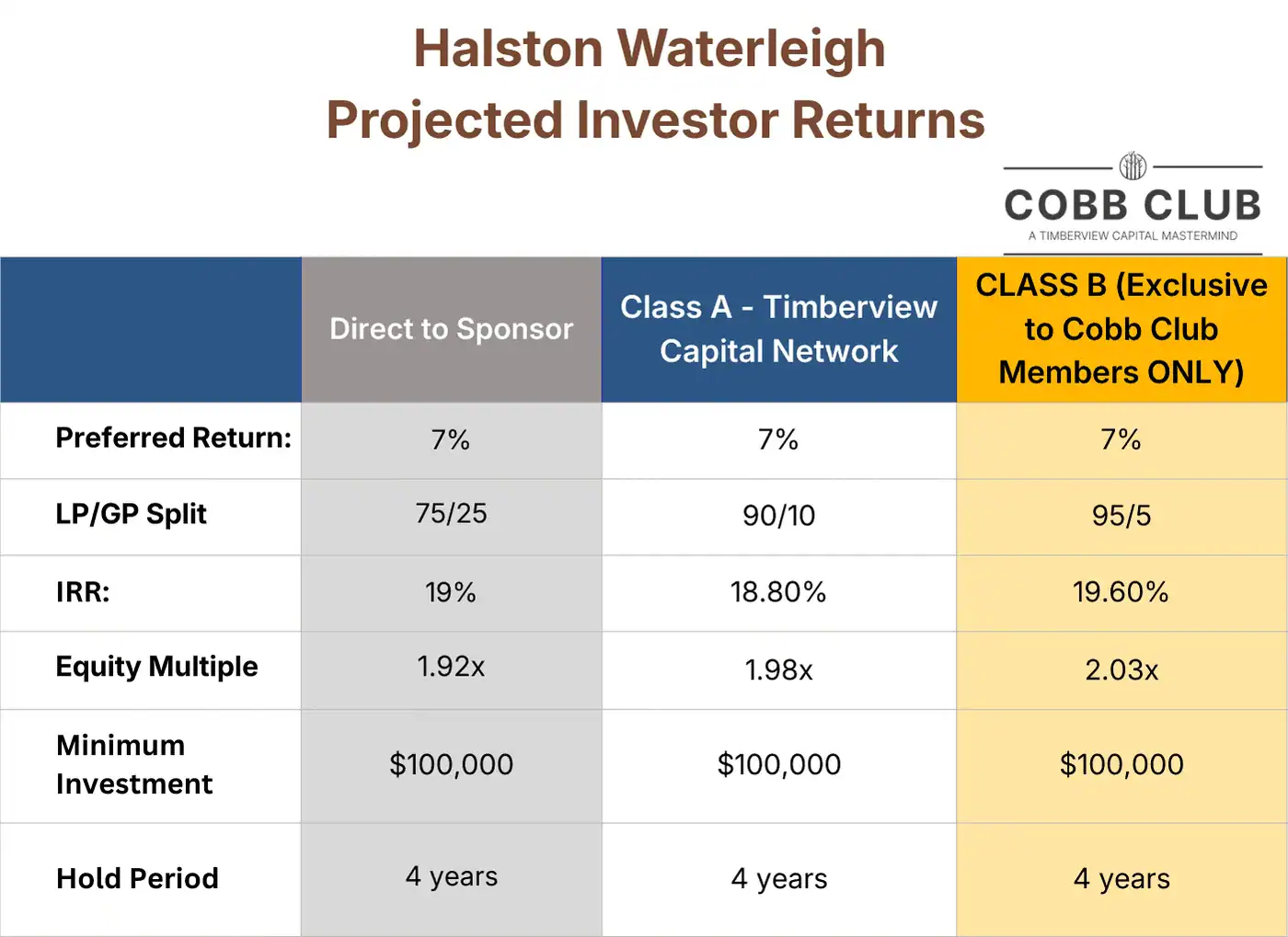



Key Highlights
- Superior Returns We have negotiated superior returns for the Timberview Capital network compared to going directly with the sponsor.
- Exceptional Basis Acquired below replacement cost at a compelling cap rate for new construction, providing built-in downside protection.
- Strong In-Place Performance Occupancy trending around 93%, outperforming newer competing deliveries in the submarket.
- Mark-to-Market Rent Upside In-place rents are ~$75–$100 below market, offering immediate and ongoing upside.
- High-Growth Orlando Submarket Minutes from Disney World in Horizon West, backed by strong population and job growth, plus top-rated schools.
- Operational Scale & Efficiencies Ownership of adjacent Birchstone Waterleigh enables shared costs, operational efficiencies, and stronger NOI.
What multifamily investing actually means
We started as a small group of physicians investing together, and apartments were one of the first places we put money to work. Most of us came to it the same way you might: plenty of income, very little time, and no interest in fixing a leaking faucet at two in the morning.
Multifamily investing means owning part of a residential property with many units, usually an apartment community. In the kind of deal we bring to the network, you are not the landlord. A sponsor finds the property, arranges the loan, runs the business plan and oversees property management. You invest as a limited partner alongside other investors, and your role is passive.
That structure is called a syndication. The sponsor (the general partner) does the work and carries the operating responsibility. Limited partners put in capital and receive regular reporting. The offering documents spell out exactly how the deal is structured, what the sponsor is paid, and what happens when the property is sold.
If you want the longer version, start with our articles on the advantages of multifamily syndications and why syndications fit busy medical professionals.
Why physicians and other high-income professionals look at apartments
People always need a place to live. That simple fact is why apartments are one of the most widely owned types of commercial real estate. Demand is driven by jobs, household growth and the cost of buying a home, not by one tenant or one industry.
Apartments also spread risk across many households. If one unit sits empty, the others are still leased. Leases are typically short, so rents can adjust to the market over time, for better or worse.
For a busy clinician, the appeal is usually less about any single deal and more about owning a real, physical asset without taking on a second job. A good sponsor handles the operations. Your job is to understand what you are buying, choose sponsors carefully, and size each investment so it fits the rest of your plan.
Apartments are not a sure thing. Interest rates, local supply, operating costs and the broader economy all matter. We cover those risks below, and in our article on how multifamily has held up in economic downturns. For a side-by-side with public markets, see multifamily vs. the stock market for a physician’s retirement portfolio.
What we look at before a deal reaches the network
Every offering we bring to members is vetted on four things: the team, the market, the location, and the business plan. In plain terms, here is what that means for an apartment deal.
The team
How long the sponsor has operated apartments, how many full cycles they have completed from purchase to sale, and how they handled the deals that did not go to plan. We want to know who runs property management and whether the sponsor invests its own money alongside ours.
The market
Job and population trends, how much new supply is being built nearby, and what is driving rental demand in the metro. A great building in a soft market can still struggle.
The location
The neighborhood, schools, access to employers, and how the property compares with the competing communities a renter would also tour. We look at it the way a tenant would.
The business plan
What the sponsor plans to change, what it will cost, how the purchase is financed, and how conservative the assumptions are. We pay close attention to the debt: the loan terms, the rate structure, and how much room there is if things take longer than expected.
Questions a physician investor should ask any multifamily sponsor:
- How many apartment deals have you taken full cycle, and how did the ones that struggled turn out?
- Who manages the property day to day, and is that team in-house?
- How is the purchase financed, and what happens if rates stay high?
- What has to go right for the business plan to work?
- How much of your own capital is in the deal?
- What fees does the sponsor earn, and when?
- How often will I get updates, and what will they include?
- How long should I expect my money to be tied up?
The risks of multifamily investing
All investments involve risk, including loss of principal. With an apartment syndication, these are the ones we would want to understand first:
- Interest rates and debt. Most apartment deals use a loan. Higher rates, or trouble refinancing, can strain a property.
- Occupancy and rents. New supply nearby, job losses or a weaker local economy can mean more vacancies or lower rents.
- Operating costs. Insurance, property taxes, payroll and repairs can rise faster than planned.
- Execution. Renovations and operational changes can take longer or cost more than expected.
- Capital calls. Some offerings allow the sponsor to ask investors for more capital if the property needs it.
- Liquidity. This is a private placement. You generally cannot sell your interest early, so plan on this money staying invested until the property is sold.
Multifamily real estate investing: common questions
What is multifamily investing?
It means owning part of a residential property with multiple units, most often an apartment community. Through a syndication, you invest passively as a limited partner while the sponsor buys and operates the property.
What is an apartment syndication?
A group of investors pools capital to buy a property that would be too large to buy alone. The sponsor (general partner) finds the deal, arranges financing and runs the business plan. Investors (limited partners) provide capital and receive regular reporting. The offering documents explain the structure, the sponsor’s fees, and what happens at sale.
Do I have to deal with tenants or repairs?
No. In a syndication, the sponsor and its property management team handle leasing, maintenance and day-to-day operations. Your role is to review the offering, decide whether to invest, and read the updates.
Who can invest?
Offers are made only to verified accredited investors pursuant to Rule 506(c) of Regulation D, through a private placement memorandum and related offering documents. An individual can generally qualify as an accredited investor with income exceeding $200,000 (or joint income with a spouse of more than $300,000) in each of the last two years with the expectation of the same this year, or a net worth exceeding $1 million excluding the primary residence, or by holding in good standing a Series 7, 65 or 82 license. For more information, see this bulletin from the SEC.
What is the minimum investment for Halston Waterleigh?
$100,000 through the Timberview Capital Network. The offering documents describe the full terms.
How long is my money tied up?
Apartment syndications are long-term, illiquid investments. You generally cannot withdraw early, and the timing of a sale depends on the property and the market. Halston Waterleigh has a projected hold period of four years. Projections can change, and the offering documents describe the full terms.
Can I invest through a retirement account?
Some investors use a self-directed IRA or Solo 401(k). Whether that works for a given offering depends on the offering documents and your custodian, so talk with your own tax and financial advisors first.
How does Timberview choose multifamily sponsors?
We vet every offering on the team, the market, the location, and the business plan, with close attention to the sponsor’s track record and how the deal is financed. We also encourage every member to do their own due diligence. Our Historical Portfolio shows the apartment communities we have invested in before.
Invest Alongside Other Physicians
Members of the Timberview Capital Network get access to vetted multifamily offerings like Halston Waterleigh, along with webinars and education from physicians who have been doing this for years.
Apply to Join the Network Already a member? Review Halston Waterleigh. Membership is by application.